
A research team from Columbia Engineering has discovered a hybrid crystal-glass material with unique thermal conductivity properties, a breakthrough that could transform thermal management technologies in electronics, waste heat recovery, aerospace, and beyond. The findings were published on July 11 in the Proceedings of the National Academy of Sciences.
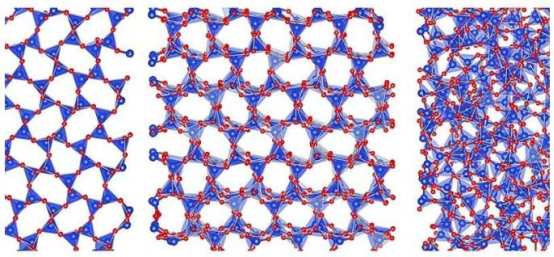
Led by Assistant Professor of Applied Physics and Applied Mathematics Michele Simoncelli, an international team combined quantum mechanical theory with machine learning to successfully predict and verify the thermal conductivity behavior of a special silica material. This material, known as "squamite," was first discovered in meteorites and later confirmed on Mars. Its thermal conductivity remains stable across a temperature range of 80K to 380K.
"This is the first time we have theoretically predicted and experimentally verified a material that simultaneously exhibits the thermal conductivity characteristics of both crystals and glasses," Simoncelli said. The study builds on the team's unified theory proposed in 2019, which successfully explained the markedly different thermal conduction phenomena in crystals and glasses.
An experimental team from Sorbonne University in France tested samples from the 1724 Steinbach meteorite in Germany, confirming the theoretical predictions. Lead experimenter Etienne Balan noted: "The thermal conduction behavior of this material resembles the famous Invar effect, offering new ideas for thermal control under extreme temperature differences."
The discovery holds significant industrial application value. The study suggests that refractory bricks in steel mills may develop similar structures after prolonged use. Simoncelli's team believes that new materials developed based on this discovery could improve thermal efficiency in steelmaking, providing technical support for reducing carbon emissions in the steel industry.
The research team is expanding this discovery to broader applications. Using AI-assisted first-principles calculations, they are working on developing new thermoelectric materials, perovskite solar cells, and thermal barrier coatings. These technologies are expected to drive progress in emerging fields such as wearable devices and neuromorphic computing.