
Egyptian researchers have developed an artificial intelligence (AI) model to detect damage on solar panels used in space. The study analyzed images of solar arrays affected by arcing, a discharge phenomenon that occurs when high-voltage solar panels interact with space plasma.
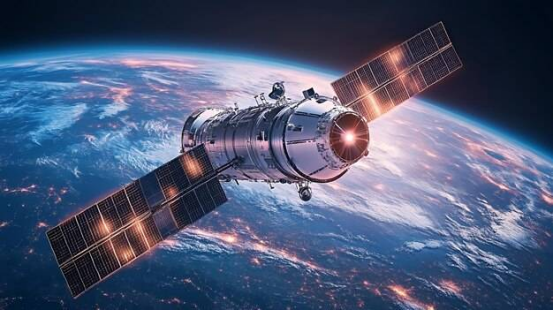
The research notes that arcing generates high peak currents, severely damaging cell interconnects and significantly affecting spacecraft system performance and reliability. It was found that arcing most commonly occurs at inter-cell connectors, edges, and mid-cell regions where the electric field is strongest.
Conducted jointly by scientists from the National Research Institute of Astronomy and Geophysics and Beni-Suef University, the study employed deep learning to understand arcing behavior. The team used convolutional neural networks (CNNs) and transfer learning to classify and detect defective cells from image data.
The team analyzed 2,624 black-and-white images of solar cells taken from 44 independent modules, some operating normally and others showing clear faults, including cracks and surface contamination caused by arcing.
To evaluate performance, the researchers tested two different AI models. The first was a network built from scratch, achieving nearly 95.98% accuracy on previously seen images but dropping to 83.24% on new images, indicating limited reliability outside the lab. The second approach used transfer learning with a pre-trained EfficientNetV2L model, achieving 89.05% validation accuracy and performing well on unseen images.
Both models successfully identified arcing-related damage, particularly in the most discharge-prone areas of solar cells: interconnects, edges, and mid-cell regions.
The researchers concluded that deep learning is an effective method for identifying arcing damage on solar panels. They stated that this work provides valuable insights for image processing and analysis, offers recommendations for further AI applications in engineering and aerospace industries, helps deepen understanding of arcing processes, improves predictive capabilities of AI models, and supports the design of more robust space solar array systems.
Future research will involve using machine learning techniques for simulation to predict arcing event behavior in scenarios involving "arc currents, potentials, and flashover on solar arrays."