
In recent months, K2-18b—a sub-Neptune-sized planet orbiting a red dwarf star 124 light-years away—has been a focal point of scientific debate. Scientists from the University of Cambridge previously used James Webb Space Telescope (JWST) data to model the planet's atmosphere, claiming detection of dimethyl sulfide (DMS) and dimethyl disulfide (DMDS)—molecules produced only by living organisms on Earth. However, this conclusion was quickly challenged by other teams who analyzed the same data and reached different results.
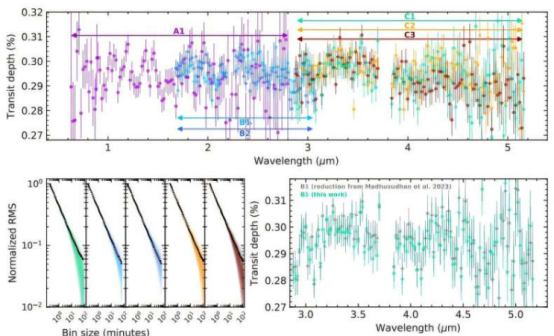
With deeper research, scientists have obtained more clues about K2-18b's atmospheric composition. The planet has been confirmed to possess a hydrogen-rich atmosphere containing methane and possibly carbon dioxide. Although evidence for ammonia and water vapor remains limited, scientists are eager to clarify these molecules with future data. Recently, a group of scientists jointly analyzed the latest four near-infrared transit observations from JWST, combined with earlier JWST and Hubble data, and released their findings on the arXiv preprint server. The new results show no evidence of DMS or DMDS features but provide a clearer picture of the planet's structure. The study's greatest achievement is confirming K2-18b as a water-rich planet, with the research team detecting methane and carbon dioxide in the atmosphere. "The simultaneous presence of CH₄ and CO₂ within the observed abundance range can only be explained by two scenarios: either a thick atmosphere or a thin atmosphere overlying a liquid water ocean. Regardless of whether a liquid water ocean exists, K2-18b has a water-rich interior," the researchers explained.
Additionally, the study found no ammonia or carbon monoxide in the planet's atmosphere. Scientists noted that the absence of ammonia is consistent with a liquid ocean, but more observations are needed to obtain information about the carbon dioxide-to-carbon monoxide ratio. Meanwhile, the lack of water vapor in the atmosphere may indicate the presence of a cold trap. Further observations will help refine atmospheric models and better understand the form of water on K2-18b. Although no evidence of life has been found, K2-18b remains a fascinating research subject.