
A research team at Vanderbilt University in the United States has published significant findings in the journal Science Advances, successfully developing a novel ultra-thin optical device based on metal-semiconductor nanostructures. This innovative technology achieves highly efficient multi-color light conversion by precisely controlling energy transfer between gold and copper sulfide nanoparticles, bringing breakthrough advancements to the fields of medical monitoring and environmental detection.
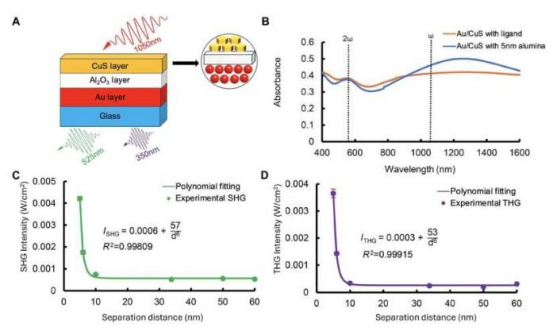
The research team creatively constructed a nano “sandwich” structure with a thickness of only one percent of a human hair, utilizing femtosecond laser excitation to trigger resonant energy transfer between the particles. Project leader Dr. Yan Yueming explained: “We have discovered an unprecedented rapid energy exchange mechanism between metal and semiconductor nanoparticles, which can efficiently convert infrared light into visible light and even ultraviolet light.”
The study features the following key breakthroughs:
Development of ultra-thin flexible optical devices (thickness<100 nanometers)
Achievement of highly efficient multi-band light conversion (infrared → visible → ultraviolet)
Energy transfer speed reaching femtosecond scale
Extremely low power consumption of the device, ideal for wearable applications
In medical applications, this technology demonstrates tremendous potential. Dr. Yan stated: “We are developing bandage-sized imaging patches that can simultaneously monitor the growth of healthy tissue and the formation of scar tissue. By analyzing changes in the ratios of light across different bands, doctors can more precisely evaluate treatment outcomes.” The research team specifically noted that the green light produced by the device is sensitive to healthy tissue, while blue light can effectively detect scar tissue.
Beyond the medical field, this technology also holds promise for environmental monitoring. The team is exploring the integration of nano-optical thin films into textiles or wall coatings to develop next-generation environmental sensors. These sensors will be able to detect airborne pollutants, gas leaks, and harmful substances in water with unprecedented sensitivity.
Currently, the research team is pursuing the following directions:
Optimizing device structures to improve energy conversion efficiency
Developing integration processes for flexible substrates
Exploring possibilities for implantable medical device applications
Enhancing the selectivity and stability of environmental sensors
This groundbreaking research not only provides new insights into the field of nanophotonics but also lays an important foundation for the development of next-generation smart medical devices and environmental monitoring systems. As the technology matures further, these ultra-thin, low-power optical devices are expected to replace traditional bulky optical systems, driving revolutionary changes in health monitoring and environmental sensing technologies.