
Recently, the fusion and plasma research team from the Sino-French Institute of Nuclear Engineering and Technology at Sun Yat-sen University has made a breakthrough in the study of self-organization processes in weakly magnetized plasmas. The related findings, titled “Three-Dimensional Helical-Rotating Plasma Structures in Beam-Generated Partially Magnetized Plasmas,” have been published online in the internationally renowned journal Physical Review Letters.
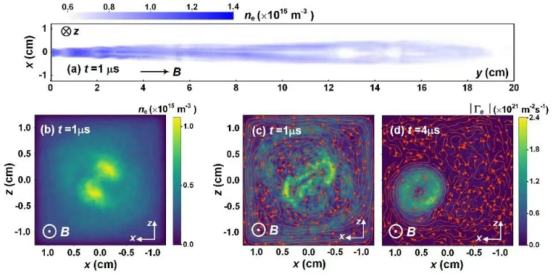
The team discovered that, under axial magnetic field confinement, plasmas can spontaneously form a completely new three-dimensional helical rotating structure, revealing its evolution characteristics and formation mechanism, and providing a brand-new analytical perspective for existing experimental observations.
The self-organization phenomenon in weakly magnetized plasmas is a key scientific issue in plasma physics research. Previous studies believed that such plasmas mainly form two-dimensional azimuthal spoke-like structures. However, through systematic investigation of the characteristics of weakly magnetized plasmas generated by electron beam ionization, the team found that they can spontaneously evolve into a collective three-dimensional helical rotating mode. The study points out that the self-organization process of this three-dimensional helical structure is primarily driven by the Diocotron instability excited by shear effects. The team further established an analytical model and carried out preliminary experimental verification, revealing a new mode of azimuthal structures in weakly magnetized plasmas and its underlying physical mechanism. This research holds significant implications for the application of weakly magnetized electron beam plasmas in fields such as etching, material surface modification, and electric thrusters.
It is reported that Associate Professor Chen Jian from the Sino-French Institute of Nuclear Engineering and Technology is the first author and co-corresponding author of the paper, Professor Wang Zhibin and Associate Professor Yu Yi are co-corresponding authors, and Dr. Andrew T. Powis and Professor Igor D. Kaganovich from Princeton University are collaborating authors. This research was supported by the National Natural Science Foundation of China, the Guangdong Provincial Natural Science Foundation, and the National Key R&D Program.