
Recently, the Hubble Space Telescope, a collaboration between NASA and ESA, captured a sharp image of the spiral galaxy NGC 3285B. The galaxy is located in the constellation Hydra, approximately 137 million light-years from Earth. Hydra, the largest of the 88 constellations covering the entire sky, spans about 100 degrees across the celestial sphere—requiring nearly 200 full moons placed side by side to stretch from one end to the other.
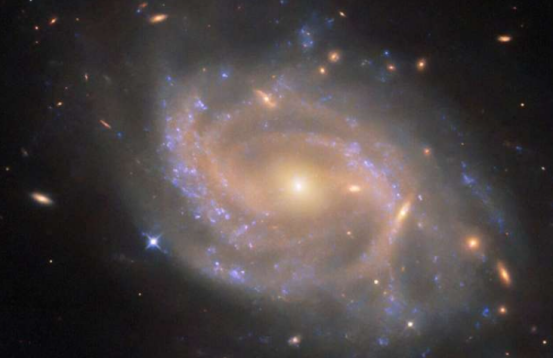
NGC 3285B is a member of the Hydra I Galaxy Cluster, one of the larger galaxy clusters in the nearby universe, consisting of hundreds to thousands of galaxies bound together by gravity. The central region of the Hydra I Cluster is dominated by two massive elliptical galaxies, each about 150,000 light-years in diameter—roughly 50% larger than the Milky Way. NGC 3285B, however, lies on the outskirts of the cluster, far from the massive central galaxies. The galaxy has attracted particular attention because it hosted a Type Ia supernova, SN 2023xqm, which exploded in 2023. Type Ia supernovae originate from the nuclear explosion of a white dwarf star and can briefly reach a luminosity 5 billion times that of the Sun. In the Hubble image, SN 2023xqm appears as a bright blue dot on the left edge of the galaxy’s disk.
This Hubble observation of NGC 3285B is part of a broader program targeting 100 Type Ia supernovae. Researchers are observing each supernova across ultraviolet, visible, and near-infrared wavelengths to disentangle the effects of distance and dust on the observed light. Both distance and dust redden the appearance of supernovae, making them appear redder than they actually are. The program aims to refine the cosmic distance ladder measurements that rely on Type Ia supernovae as “standard candles.”