
Researchers from Rice University and collaborating institutions have found direct evidence of active flat electronic bands in a kagome superconductor. This breakthrough could pave the way for new approaches to designing quantum materials—including superconductors, topological insulators, and spintronic devices—that may power future electronics and computing technologies.
The study was led by Pengcheng Dai, Ming Yi, and Qimiao Si from Rice University’s Department of Physics and Astronomy and the Smalley-Curl Institute, in collaboration with Di-Jing Huang from the National Synchrotron Radiation Research Center in Taiwan. The results were published in Nature Communications. The research focused on the chromium-based kagome metal CsCr₃Sb₅, which becomes superconducting under pressure.
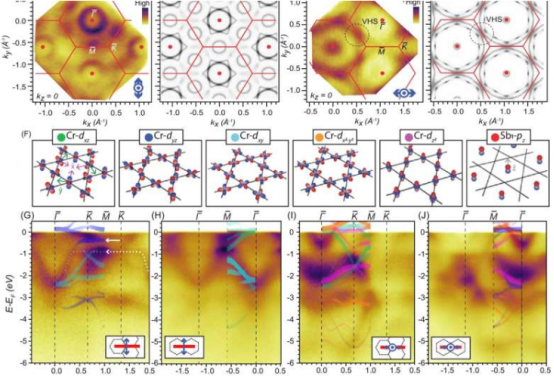
Kagome metals are characterized by a two-dimensional lattice of corner-sharing triangles and have recently been predicted to host compact molecular orbitals—standing wave patterns of electrons—that could enable unconventional superconductivity and novel magnetic order activated by electron correlation effects. In most materials, these flat bands are too far from the activation energy level to produce significant effects; however, in CsCr₃Sb₅, they actively participate and directly influence the material’s properties.
“Our findings confirm a surprising theoretical prediction and establish a pathway to designing exotic superconductivity through chemical and structural control,” said Pengcheng Dai, Sam and Helen Worden Professor of Physics and Astronomy.
The discovery provides experimental evidence for ideas that previously existed only in theoretical models and demonstrates how the complex geometry of the kagome lattice can be used as a design tool to control electron behavior in solids.
“By identifying active flat bands, we demonstrate a direct connection between lattice geometry and emergent quantum states,” said Ming Yi, Associate Professor of Physics and Astronomy.
The research team used two advanced synchrotron techniques along with theoretical modeling to investigate the presence of active standing-wave electronic modes. They employed angle-resolved photoemission spectroscopy (ARPES) to image synchrotron-emitted electrons, revealing unique features associated with compact molecular orbitals. Resonant inelastic X-ray scattering (RIXS) measured magnetic excitations linked to these electronic modes.
“Our collaborative team’s ARPES and RIXS results provide a consistent picture showing that the flat bands here are not passive spectators but active participants in shaping the magnetic field and electronic landscape,” said Qimiao Si, Professor of Physics and Astronomy. “This is surprising because, until now, such features have only been seen in abstract theoretical models.”
Analysis of a tailored electronic lattice model provided theoretical support for strong correlation effects, reproducing the observed features and guiding the interpretation of the results. Fang Xie, a Rice University young researcher and co-first author, led this part of the study.
Rice University graduate student and co-first author Zehao Wang noted that obtaining such precise data required exceptionally large and high-purity CsCr₃Sb₅ crystals, synthesized using a sophisticated method that produces samples 100 times larger than previously achieved.
The study highlights the power of interdisciplinary research, said Yucheng Guo, Rice graduate student and co-first author who led the ARPES measurements.
“This work benefited from collaboration across materials design, synthesis, electronic and magnetic spectroscopy characterization, and theory,” Guo said.