
Scientists at Sandia National Laboratories, led by John Sandusky, have proposed a novel idea to repurpose heliostats—typically used to convert solar energy into electricity—for nighttime operations to help discover asteroids. Sandusky believes that heliostat fields are idle at night, and equipping them for nighttime work could enable the search for near-Earth objects at relatively low cost. “If we know in advance about an asteroid's arrival and impact location, we can better prepare and reduce potential damage,” Sandusky said.
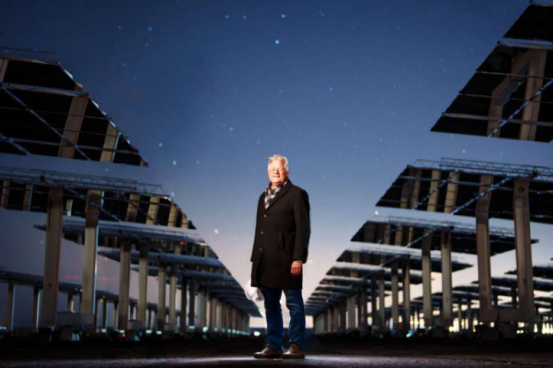
Currently, most planetary defense measures rely on observatory-grade telescopes to capture images of stars and calculate streaks representing asteroids. While precise, this method is time-consuming, and building new observatories is extremely expensive. Sandusky conducted experiments at the National Solar Thermal Test Facility, selecting one of the 212 heliostats on-site during summer nights for testing. He noted that the solar tower collects megawatts of sunlight during the day, while the nighttime goal is to collect femtowatts of sunlight—extremely faint light scattered by asteroids.
Sandusky believes heliostats can measure the speed of an asteroid passing in front of a star, rather than using traditional imaging methods. He did not add new equipment to the test heliostat, only using existing software to adjust its orientation relative to the star, allowing the heliostat to scan back and forth once per minute. At dusk transitioning to night, from 200 feet above ground on the solar tower, he used standard optical instruments to detect the light focused by the heliostat. He said: “We collect data at intervals of about 20 minutes, continuing until dawn. Initially, this was not aimed at finding asteroids, but simply to prove that the heliostat could move back and forth and observe stars.”
Sandusky pointed out that this method offers advantages beyond cost-effectiveness. For example, it could help the U.S. Space Force search for spacecraft in the cislunar region, where tracking objects in lunar orbit from the ground is difficult. Sandusky presented the results at the International Society for Optics and Photonics conference and published a paper in Unconventional Imaging, Sensing, and Adaptive Optics 2024, hoping to gather peer feedback and address concerns about the technology's operation. Next, he plans to use heliostats to search for known planets to reveal the technology's limitations, and he hopes to scale from one heliostat to multiple ones to expand the capability for detecting smaller asteroids.