
An engineering paper recently published in the international academic journal Nature reports that researchers have developed a miniature solar floating device that may support related instrumentation at high altitudes in the atmosphere. This device uses photophoresis to maintain altitude without traditional fuel, with great potential for applications such as space weather monitoring and Mars exploration.
The paper explains that photophoresis is a force that causes suspended particles in a gas (or liquid) to move when heated by light. Although this principle has been known for over a century, its practical applications have only begun to be explored recently. In the upper layers of Earth's atmosphere, where air is extremely thin, photophoresis is strong enough to allow small objects to float. However, most previous experiments have focused on very small and lightweight materials, and scaling it to larger, more practical devices has remained a challenge.
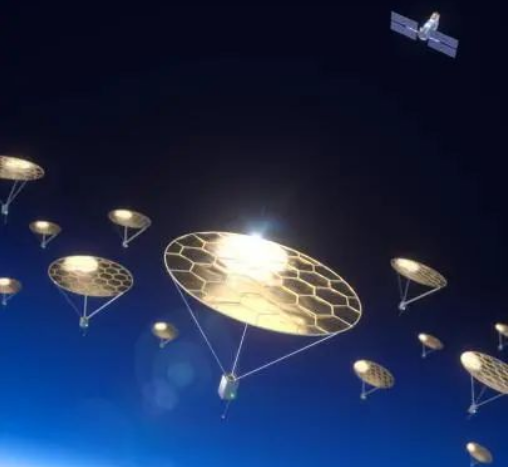
In this study, the corresponding author Benjamin C. Schafer from Harvard University, along with colleagues and collaborators, designed and built a new type of flying structure consisting of two thin, porous membranes connected by tiny vertical supports. After optimizing the photophoretic force through computer modeling and laboratory experiments, they fabricated a 1cm wide disk capable of floating under light intensity equivalent to high-altitude sunlight.
The authors also propose a 3cm wide version. Computer models show that during daytime at 75km altitude, it could carry a 10mg payload—sufficient to support a small communication system including a radio-frequency antenna, solar cells, and integrated circuits.
The paper's authors conclude that these findings highlight the potential of photophoretic flight as a tool for monitoring Earth's atmosphere or even exploring other planets. They note that current Mars transportation costs exceed $100,000 per kilogram, while photophoretic devices offer significant advantages in size, weight, and power consumption compared to dedicated Mars satellites. In the future, they could be used for sensing and communication tasks.
They reveal that future designs of photophoretic aircraft could include navigation systems, increased payload capacity and operational duration, as well as the ability to perform larger-scale missions.