
Astronomers have conducted spectroscopic observations of a high-redshift galaxy named XMM-VID1-2075 using the James Webb Space Telescope (JWST). The results, released on the preprint server arXiv on August 14, indicate that XMM-VID1-2075 is a massive and evolved slowly rotating galaxy.
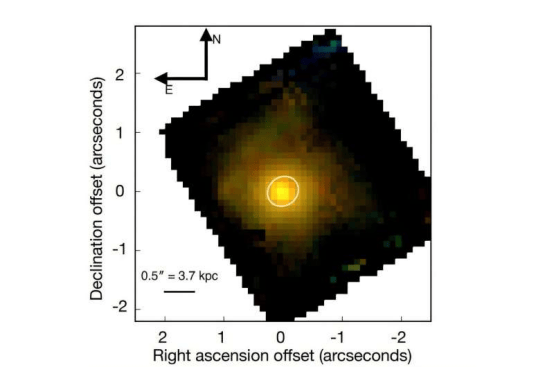
So-called “slowly rotating galaxies” represent a small fraction of the most massive galaxies that have ceased star formation and are supported by dispersion. These highly evolved galaxies are typically found in dense galaxy cluster environments.
To date, no slow-rotating systems at redshifts greater than 2.0 have been confirmed kinematically from stellar motions. It is generally believed that such slowly rotating systems are expected to be rare at high redshifts.
However, a team of astronomers led by Ben Forrest from the University of California, Davis, recently discovered such a high-redshift slowly rotating galaxy. Using the Near-Infrared Spectrograph (NIRSpec) and Near-Infrared Camera (NIRCam) on JWST, they report that the galaxy XMM-VID1-2075 at redshift 3.45 exhibits characteristics consistent with the lack of rotation seen in slowly rotating galaxies in the local universe.
According to the paper, XMM-VID1-2075 was initially selected by Forrest and colleagues from the near-infrared catalog of the VISTA Deep Extragalactic Observations (VIDEO) survey due to its apparent brightness, photometric redshift, and red spectral energy distribution.
The observations confirm that XMM-VID1-2075 has a high redshift and a large stellar mass of approximately 330 billion solar masses. The collected data indicate a star formation rate of less than one solar mass per year, with a large stellar velocity dispersion of about 379km/s.
Additionally, astronomers measured the semi-major axis of XMM-VID1-2075, resulting in approximately 7,300 light-years. Combined with its ellipticity of 0.11, the circularized effective radius is calculated to be 6,500 light-years.
Most importantly, JWST observations show that XMM-VID1-2075 exhibits extended low-surface-brightness asymmetry, with an estimated spin parameter of 0.1. These findings indicate that XMM-VID1-2075 possesses slow rotation characteristics and suggest the presence of merger activity.
Thus, the results show that XMM-VID1-2075 is the highest-redshift slowly rotating galaxy confirmed kinematically from stellar motions to date. The paper’s authors add that, although XMM-VID1-2075 is smaller than local slowly rotating galaxies, it is kinematically more similar to the most massive early-type galaxies in the local universe than other high-redshift galaxies observed so far.
The researchers conclude that their findings indicate merger activity played a key role in the formation and kinematic transformation of some of the most massive galaxies when the universe was less than 2 billion years old.