
Scientists at Virginia Tech have discovered a method to make ice move on its own. This is not magic or a supernatural phenomenon, but a clever engineering achievement with numerous potential applications in rapid de-icing and new ways to harness green energy.
The researchers drew inspiration from the “sailing stones” of Racetrack Playa in Death Valley. This rare natural phenomenon occurs when rainwater falls on the hard desert ground, temperatures drop below freezing at night forming a thin ice layer, and when the ice melts, light winds can push the remaining ice sheets, sometimes carrying rocks across the dry lake bed.
Inspired by this, Jonathan Boreyko and his team from Virginia Tech’s Nature-Inspired Fluids and Interfaces Laboratory set out to create a surface that allows ice to move along a horizontal path without wind assistance. After five years of work, they successfully published their findings in ACS Applied Materials & Interfaces.
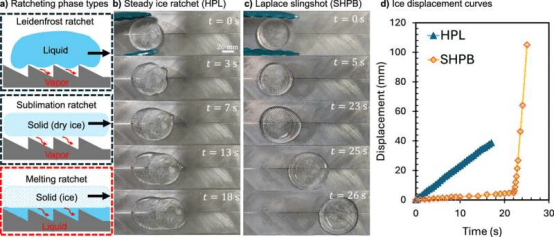
The scientists fabricated special aluminum plates etched with fine V-shaped herringbone grooves. They froze water in a petri dish to create an ice disk and placed it on the heated aluminum plate. As the ice melted, the water was guided forward by the grooves, and the herringbone pattern prevented backflow. The team also sprayed some metal plates with a waterproof coating and found that the ice disk initially stuck to the coated surface but then quickly slid across the metal plate.
The researchers believe their work has broad implications. They wrote in the paper: “These findings demonstrate the potential for passive de-icing and phase-controlled micro-transport through controlled melting and surface-guided motion, which is significant for anti-icing systems, self-cleaning surfaces, and passive microfluidic transport.”
While the new research is exciting, the scientists acknowledge that more work is needed to fully explore its potential. One of the most promising applications could be energy harvesting—for example, by fabricating the metal plates into a circular pattern so the melting ice disk continuously rotates, then connecting magnets or turbines to the rotating ice disk to generate electricity.