
A research team from Rutgers University has published groundbreaking findings in Science Advances, observing for the first time a new quantum state of matter at the interface between a Weyl semimetal and a spin ice material. This discovery provides an important theoretical foundation for developing new quantum materials.
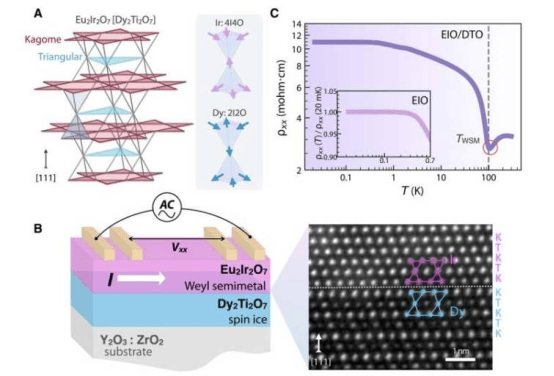
Led by Professor Jak Chakhalian from Rutgers University’s Department of Physics and Astronomy, the team created a heterostructure by combining two special materials and discovered this new quantum state under strong magnetic fields and extremely low temperatures. Lead researcher Wu Zongqi stated: “We observed an entirely new quantum phase at the interface—a phenomenon that never appeared when studying these two materials separately.”
Experimental results show that at this special interface, electrons exhibit rare six-fold symmetric conduction characteristics and suddenly begin flowing in both directions under strong magnetic fields. This state, known as a “quantum liquid crystal,” differs from traditional solids, liquids, gases, or plasmas. The research team believes this discovery could open pathways for developing ultra-sensitive quantum sensors and novel electronic devices.
“The combination of experiment and theory was key,” Wu Zongqi added. “It took us more than two years to fully understand these phenomena.” Most of the experiments were conducted at the National High Magnetic Field Laboratory in Florida, requiring extremely low temperatures and strong magnetic fields.
The Quantum Phenomena Discovery Platform (Q-DiP) developed by the research team provides technical support for fabricating such special heterostructures. Professor Chakhalian noted: “This study not only discovers new phenomena but also lays the foundation for exploring more quantum material combinations.”