
Quantum computers have attracted great attention due to their potential capabilities. Their core component, the qubit, can be realized in various ways, such as using atomic energy levels or electron spins. However, during the fabrication of qubits, researchers face the difficult trade-off between speed and coherence time: qubits need to be isolated from the environment to maintain quantum superposition states, yet fast driving requires strong environmental interactions, which often shortens coherence time.
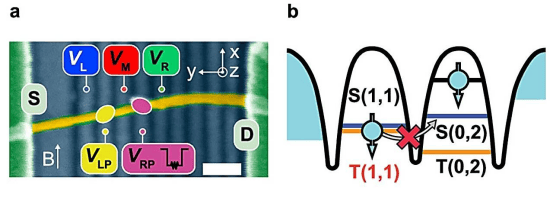
A team led by Professor Dominik Zumbühl at the University of Basel has published their latest research results in Nature Communications, successfully tuning spin qubits to achieve simultaneous enhancements in both speed and coherence time. The first author of the study, Dr. Miguel J. Carballido, explained: “We explored a smart ‘step on the gas pedal’ approach rather than simple acceleration.” The team constructed a micro-device using germanium semiconductor material to form nanowires coated with a thin layer of silicon. By removing electrons, they created “holes” whose behavior resembles bubbles.
Theoretical physicists had previously predicted that specific spin-orbit coupling mechanisms could enable faster driving speeds and longer coherence times. The Basel University researchers utilized this mechanism by electrically controlling spin-orbit coupling—where moving charged particles generate magnetic fields that interact with the particle’s spin, affecting its energy. By applying voltage to the nanowire, they controlled the mixing states of hole energy levels and discovered that under specific mixing conditions, there exists a plateau phase: increasing the driving strength does not accelerate the qubit but instead slows it down while reducing the impact of environmental electric field fluctuations on the qubit, thereby extending coherence time.
Dr. Carballido stated: “We successfully increased the qubit coherence time by four times and improved the driving speed by three times.” Additionally, this technology operates at a relatively higher temperature, requiring only 1.5 Kelvin, which reduces energy consumption and dependence on scarce helium-3. Currently, this “plateau technique” is only applicable to specific nanowires, but the team hopes to extend it to two-dimensional semiconductors and other types of qubits in the future, laying the foundation for building more powerful quantum computers.