
A research team from Rensselaer Polytechnic Institute in the United States has published two significant achievements in the journal Advanced Materials, demonstrating an innovative method for regulating the properties of functional materials using structured light. This research provides new ideas for developing next-generation storage devices and photocatalytic materials.
The research team, led by Physics Professor Moussa N'Gom and Materials Science Professor Edwin Fohtung, successfully modulated the polarization properties of ferroelectric materials using "twisted light." N'Gom stated: "We can precisely manipulate photons like using a wrench, targeting and adjusting the electric field configuration of specific atomic groups inside the crystal." The experiment employed X-ray imaging technology to capture real-time three-dimensional changes in the internal structure of the material.
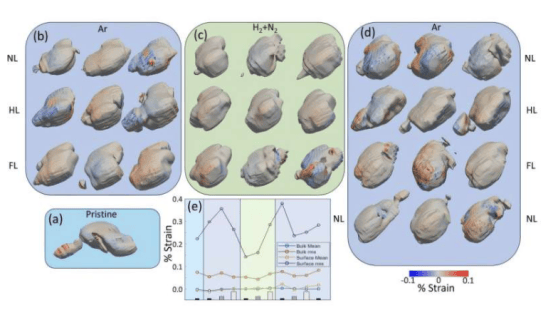
In the second study, scientists observed for the first time the dynamic changes of individual functional material nanocrystals in real environments. Fohtung noted: "This breakthrough allows us to directly observe the mechanisms of performance changes in materials at the nanoscale, laying the foundation for designing more efficient catalysts."
The research shows that light irradiation can not only alter the surface area of bismuth tungstate but also regulate its metal-semiconductor phase transition. N'Gom added: "Structured light technology can significantly enhance the activity efficiency of photocatalytic materials under visible light."