
According to TASS on August 19, Russian physicists have developed a theoretical model that consistently describes the mechanism of dangerous vertical plasma instabilities in the operation of tokamak thermonuclear reactors. This paves the way for creating more reliable control systems for thermonuclear reactors, as reported by the Scientific Communications Center of the Moscow Institute of Physics and Technology (MIPT).
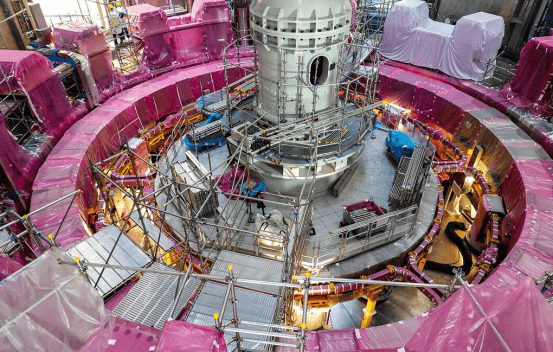
Vladimir Pustovitov, a researcher at MIPT, explained that previous models, although sophisticated and capable of solving problems relatively simply, had a narrow range of applicability. Their initial assumptions required that when the plasma shape changes, the shape of the vacuum chamber must also change accordingly. The newly created universal method can be applied to both existing and planned tokamaks, including the International Thermonuclear Experimental Reactor (ITER).
Scientists note that over the past half-century, physicists have developed various approaches to building thermonuclear reactors, with tokamaks and stellarators considered the most promising. Tokamaks are closer to practical application, particularly due to the ITER reactor, which has been under construction in France for decades and involves scientists from Russia, the EU, the United States, China, and other countries.
In a tokamak device, plasma is formed and confined inside, reaching temperatures of hundreds of millions of degrees. To increase power and improve efficiency, physicists design the plasma cross-section to be elongated (vertically stretched), but this leads to vertical instability: the plasma can become unstable in the vertical direction, “sliding” up or down and risking high-speed collision with the chamber walls.
To counteract such situations, it is essential to accurately understand the formation and growth rate of vertical instabilities. However, existing mathematical models rely on mathematical simplifications tied to the elongated plasma geometry and the conductive wall shape of the tokamak vacuum chamber, which prevents sufficiently precise predictions.
The new method developed by theoretical physicists from MIPT and the Kurchatov Institute is more universal and can account for plasma and wall shapes of arbitrary form that are independent of each other. Calculations by the researchers show that the new approach achieves higher consistency with experimental data. In the future, it will help create more accurate control algorithms for tokamak devices, protect them from such events, and improve the design and geometry of critical components.