
A research team at The Ohio State University has developed an innovative method that enables liquid crystal materials to retain motion information and achieve directional memory. This study, published in Nature Physics, opens new pathways for developing novel storage devices and smart flexible materials.
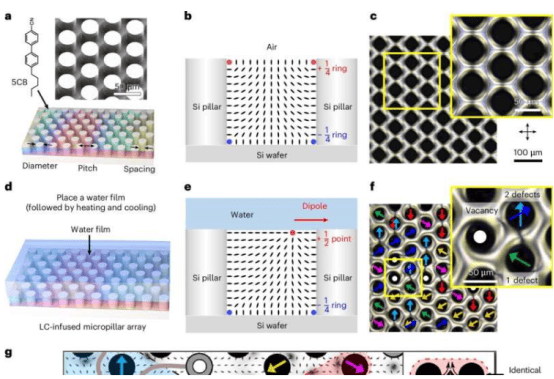
The team, led by Professor Xiaoguang Wang from the William G. Lowrie Department of Chemical and Biomolecular Engineering, discovered through experiments that external forces such as water droplets can precisely control the alignment direction of liquid crystal molecules. Professor Wang stated: “Our system can remember the vector direction of the written information, functioning just like a storage device.” The research shows that liquid crystal molecules can rapidly respond to changes in droplet position and maintain the new orientation.
This technology is realized by etching columnar structures on a silicon wafer and then infusing it with liquid crystals. Former graduate research assistant Ufuoma Kara noted: “This polar ordered control brings entirely new application possibilities to liquid crystals.” The researchers believe this breakthrough could not only revolutionize the design of storage devices but also drive the application of flexible materials in areas such as processors.
The team is currently working to scale up this technology for larger applications. Kara added: “This discovery lays the foundation for exploring new physical properties of liquid crystal materials.”