
Scientists from the Quantum Control Laboratory at the Sydney Nano Institute, University of Sydney, have made a key breakthrough in quantum computing by demonstrating, for the first time, a quantum logic gate that significantly reduces the number of physical qubits required to build large-scale quantum computers. The research team utilized the Gottesman-Kitaev-Preskill (GKP) error-correcting code to construct an entangling logical gate within a single trapped ion (a charged ytterbium atom), opening a new path toward highly efficient quantum computing hardware design.
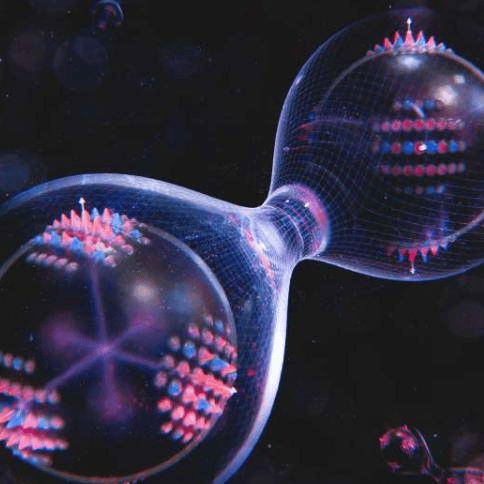
The GKP code, dubbed the “Rosetta Stone of quantum computing,” earned its name because it converts continuous quantum oscillator states into discrete ones. Its theoretical advantage lies in dramatically reducing the number of physical qubits needed for each logical qubit. However, due to the complexity of encoding and control challenges, this technology had remained largely theoretical for a long time. The University of Sydney team achieved, for the first time, a universal logical gate set for GKP qubits by precisely controlling the harmonic motion of the trapped ion. “We used the quantum vibrations of a single atom to store two error-correctable logical qubits within the same ion and demonstrated entanglement between them,” said project leader Dr. Tingrei Tan. “This breakthrough was made possible by software developed in collaboration between our Quantum Control Laboratory and the startup Q-CTRL. The software optimizes quantum gate designs using physical models, minimizing distortion in GKP logical qubits to the greatest extent.”
In the experiment, the team confined a single ytterbium ion in a room-temperature Paul trap and used a laser array to control its three-dimensional vibrations, generating complex GKP codes. First author Vassili Matsos noted: “The logical gate realized by entangling two quantum states within the same atom represents an important milestone in quantum technology.” This achievement not only validates the physical feasibility of the GKP code but also demonstrates that it can improve computational efficiency by reducing the number of physical qubits required, providing a critical tool to address the resource overhead challenges in scaling quantum computers. Dr. Tan concluded: “Our work lays the foundation for large-scale quantum information processing and holds promise for realizing quantum programming with far more efficient hardware in the future.”