
Since the discovery of planetary nebulae in the late 18th century, astronomers have known that these gas shells ejected by low- to intermediate-mass stars at the end of their lives exhibit a wide variety of shapes. Recent high-resolution images captured by the NASA/ESA/CSA James Webb Space Telescope of planetary nebula NGC 6072 reveal a multipolar structure that challenges traditional models. Observed with the Near-Infrared Camera (NIRCam), the nebula shows multiple elliptical outflows ejected from the center, with gas compressed into a disk in the equatorial plane. Astronomers suggest this morphology may result from the interaction of at least two central stars—a companion star interacting with the aging primary star, causing outer layers of gas and dust to be shed.
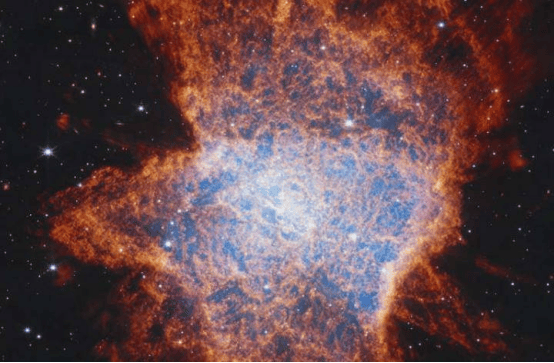
The image shows the central region of NGC 6072 glowing pale blue due to the hot stellar core, while deep orange gas and dust flow along deep blue cavities. Researchers speculate that the clumpy structures may form from dense molecular material shielded by the central star’s radiation, while fast internal stellar winds have been piercing through the halo ejected during the primary star’s early mass-loss phase for thousands of years, further sculpting the shape. Mid-infrared observations with MIRI highlight dust distribution and suggest the possible presence of a hidden secondary star at the center. The orbital path of this companion around the primary star may carve spiral rings of material, providing an additional explanation for the multipolar structure. Both the red regions in NIRCam and blue regions in MIRI trace cold molecular gas (such as molecular hydrogen), while the central region displays features of hot ionized gas.
Studies of planetary nebulae are crucial for understanding stellar life cycles. As the central star cools and fades, the nebula releases its material into the interstellar medium, enriching it with heavy elements for new stars and planetary systems. Webb’s imaging of NGC 6072 offers fresh insights into how complex morphologies accelerate this process. Astronomers plan to continue using Webb to observe similar objects, refining models of stellar evolution.