
In agriculture, harvesting crops such as strawberries, asparagus, and apples has long been plagued by a shortage of skilled workers. To address this, researchers are actively developing picking robots to provide efficient assistance to agricultural enterprises. However, Professor Andreas Nüchter from the Robotics Group at Julius-Maximilians-Universität Würzburg (JMU) admits that while several picking robot prototypes already exist, their performance has yet to reach the desired level.
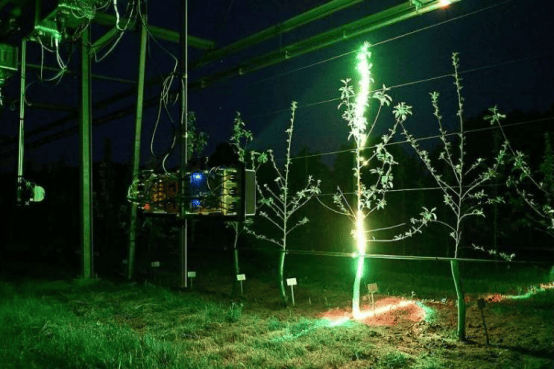
To overcome this challenge, Nüchter’s team collaborated with the Leibniz Institute for Agricultural Engineering and Bioeconomy (ATB) to develop a novel 3D laser scanning system specifically designed for field robots. The system aims to provide scientific guidance for determining optimal harvest timing by precisely measuring key plant conditions, such as fruit water content.
Currently, a team led by Dr. Manuela Zude-Sasse from ATB has successfully installed and conducted initial tests of the system at the Potsdam test field. The 3D laser scanner was deployed on a sensor transport station surrounding 120 apple trees, and the first test yielded impressive results. Professor Nüchter stated: “We are now able to measure and map plants in a meaningful way—this is crucial for the application of picking robots.”
Dr. Zude-Sasse further explained that understanding the maturity stage of fruit is essential for horticultural production, as it helps optimize planting, harvesting, and storage timing. In the context of increasingly variable growth conditions due to global warming, accurately capturing fruit development data is not only important for scientific modeling but also key to the future commercial application of picking robots.
The new sensor system will continue operating at the ATB test field until November 2025 to monitor the growth of 120 apple trees over the long term. The system is designed to be robust and durable, capable of withstanding wind and rain, and operates reliably within a temperature range of 0 to 40°C. Based on the structured light principle, it projects light of three different wavelengths onto the plants and analyzes the reflected signals to obtain precise spatial information about the plants. This capability opens new possibilities for recording physiological characteristics of plants, such as water content.
It is worth noting that the 3D laser scanner is designed for experimental use only, with high laser intensity that can damage the eyes if viewed directly. Therefore, ATB has implemented strict access controls in the measurement area to ensure that untrained personnel do not enter the vicinity of the scanner.
The project draws on JMU Robotics’ extensive expertise in optical device development and ATB’s rich experience in crop research and field plant analysis. The deployment of the new 3D plant scanner will further enhance the data foundation for modeling work and provide strong support for specifying future picking robot requirements.
Additionally, Professor Nüchter revealed that his team is developing a laser scanner for space applications to assist in water resource detection during lunar or Martian missions.