
A research team from the Ningbo Institute of Materials Technology and Engineering (NIMTE) of the Chinese Academy of Sciences has achieved a significant breakthrough by developing a new method that effectively improves the efficiency of dynamics modeling for industrial robots, addressing the long-standing bottleneck in real-time torque calculation. The research results have been published in IEEE Transactions on Industrial Informatics.
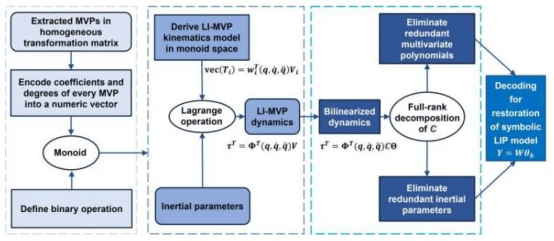
Industrial robots rely on linear parameter (LIP) dynamic models to perform critical tasks such as torque calculation and online identification of dynamic parameters, which are essential for adaptive control and robot-environment interaction. However, traditional models are susceptible to redundancy in multivariate polynomials (MVP), limiting computational speed and making real-time applications difficult.
To overcome this challenge, the research team innovatively proposed a multivariate linear multivariate polynomial (LI-MVP) dynamics model. By encoding coefficients and polynomial degrees as numerical matrices, the model significantly simplifies the dynamics modeling process and greatly improves modeling efficiency. The team also replaced the cumbersome symbolic Kronecker product with a binary operation defined in a monoid, further accelerating the derivation of the LI-MVP model in the encoded space.
Corresponding author Professor Chen Silu explained that the new method simplifies the model derivation process by simultaneously eliminating redundant MVP and parameters, and accelerates real-time torque computation. Finally, the MVP is decoded back to the symbolic LIP model using Horner form, reducing the number of multiplications required for torque calculation.
Quantitative analysis shows that the new method significantly outperforms existing approaches in model derivation efficiency and demonstrates great potential for application in model-based real-time control of industrial robots. This advancement is expected to substantially enhance the flexibility and responsiveness of robot systems, bringing new development opportunities to the high-end equipment manufacturing sector.