
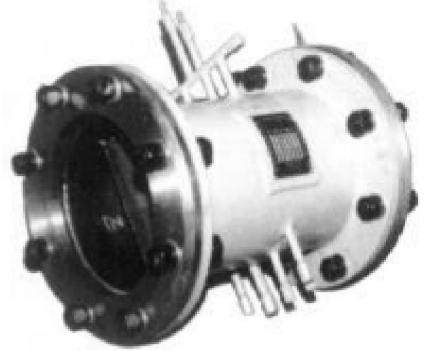


Boiler combustion stability directly affects its operational safety and economy. Unstable combustion not only impacts boiler efficiency but may even cause extinguishment. Combustion economy requires maintaining a reasonable air-to-coal ratio, proper primary and secondary air distribution, and coordinated supply and induced air volumes. Therefore, it is necessary to measure the air volume entering the boiler and flue gas oxygen content. Due to large flue cross-sectional areas, short straight pipe lengths, very low pressure loss requirements, and fluids containing dust and smoke, wing-type air measurement devices have been widely adopted in recent years for measurement in power, metallurgy, chemical, mining, and other industrial sectors.
Features
- 1) The detection body is developed with the most reasonable streamlined wing-shaped tube, achieving the minimum resistance coefficient limit, ensuring minimal irrecoverable pressure loss and low energy consumption;
- 2) Multiple wing-type velocity tubes can be used to increase detection points, improving measurement accuracy; more wing tubes shorten wing tube length and overall pipe section, reducing volume and weight;
- 3) Shortened short tube length inside the wing tube enlarges the guide tube inner diameter; external blowdown and dredging devices ensure safe operation and convenient maintenance;
- 4) Good long-term stability, wide application range, simple structure, and easy operation;
Main Technical Parameters
- 1) Duct dimensions: BXH=600X600~4000X4000mm; DN=300~3000mm;
- 2) Nominal pressure: PN≤2.5MPa;
- 3) Medium temperature: t≤450°C
- 4) Fluid viscosity: η<1 mPa·s;
- 5) Minimum Reynolds number: ReDmin>2.5×10⁵
- 6) Area ratio: A₁/A=0.35~0.38
- 7) Basic error limit: δ=±2.5%
