


Introduction
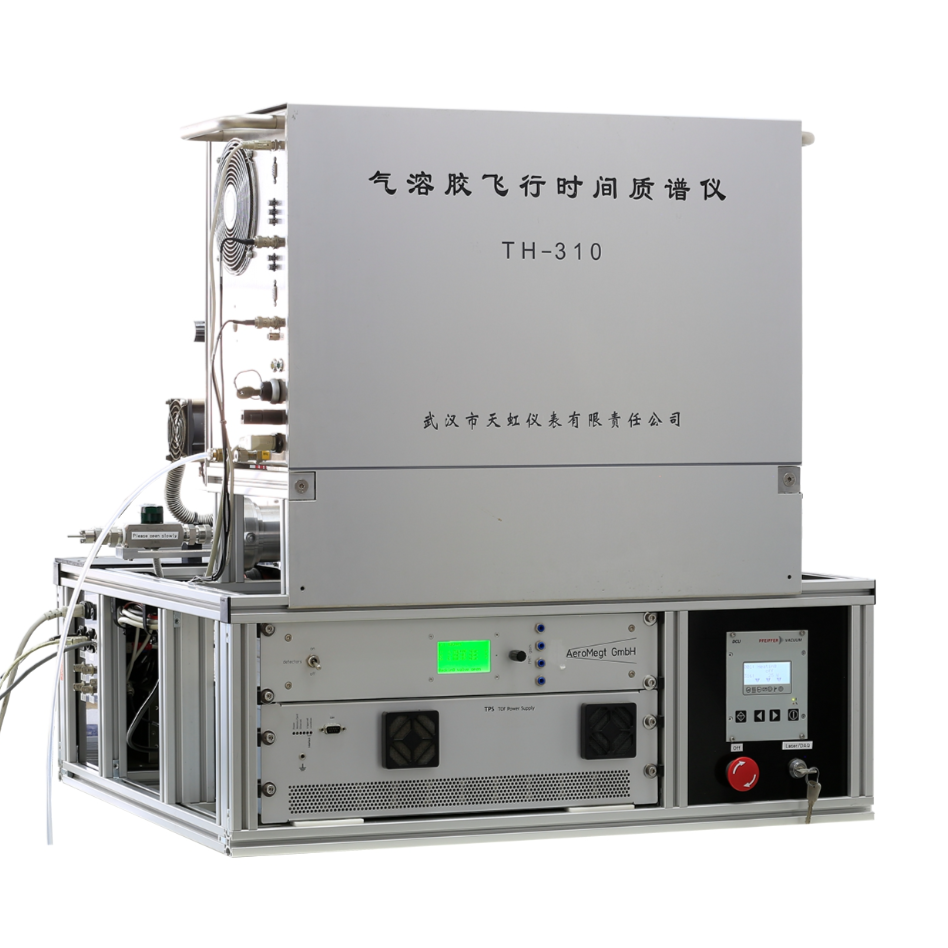
The TH-310 aerosol time-of-flight mass spectrometer belongs to the latest generation of single-particle aerosol time-of-flight mass spectrometers internationally. It was introduced by Wuhan Tianhong in 2016 using foreign technology for production. It integrates multiple world-leading technologies and is a comprehensive mass spectrometer with online sampling and single-particle sizing functions. The TH-310 uses an aerodynamic lens for sample introduction, dual-laser scattering to measure flight speed and calculate the vacuum aerodynamic diameter of particles, followed by ultraviolet pulsed laser for one-step desorption and ionization of particles, and finally bipolar time-of-flight mass spectrometry for analysis of positive and negative ions.
The basic function of TH-310 is online detection of particle size and chemical composition characteristics of individual aerosol particles, with extended function for real-time online source apportionment of PM₂.₅.
Instrument Structural Features
• Aerodynamic lens inlet — direct sampling without dilution
• Dual optical path laser scattering velocity measurement zone — multiple selectable trigger modes
• Laser ion source — stable energy, high frequency, high hit rate
• Bipolar time-of-flight mass spectrometer detector — high resolution, wide detection range
Application Scope
Environmental monitoring field: online and offline aerosol pollution source apportionment, monitoring and research of haze formation mechanisms, single-particle chemical composition analysis of PM₂.₅, and monitoring research of secondary reaction processes.
Other fields: climate change research, Mie scattering effect research of aerosol particles, engine emission research, nanomaterial and powder product research.
Instrument Features
Enables online and offline source apportionment functions
Technical highlights: The trigger laser and ionization laser are positioned very close, with the ionization laser facing the particles head-on to improve hit rate. Fast triggering and high-frequency pulsed laser enable overall detection speed of over 100 particles per second. No sample pretreatment or dilution required, with wide applicability range for PM₂.₅ concentrations.
PM₂.₅ Online Source Apportionment:
Uses characteristic ion method and class chemical mass balance method for analysis. This makes results comparable with peers while maintaining connection with traditional source apportionment methods.
Class chemical mass balance method returns single-particle data to source category level for fitting analysis. This reduces the impact of secondary reactions on aerosol particles from generation to detection and minimizes differences caused by artificial designation of characteristic ions, making source apportionment results more stable and representative.
Simultaneously considers transmission efficiency of the aerodynamic lens, Mie scattering effect, etc., performing source apportionment in segments for particles.
