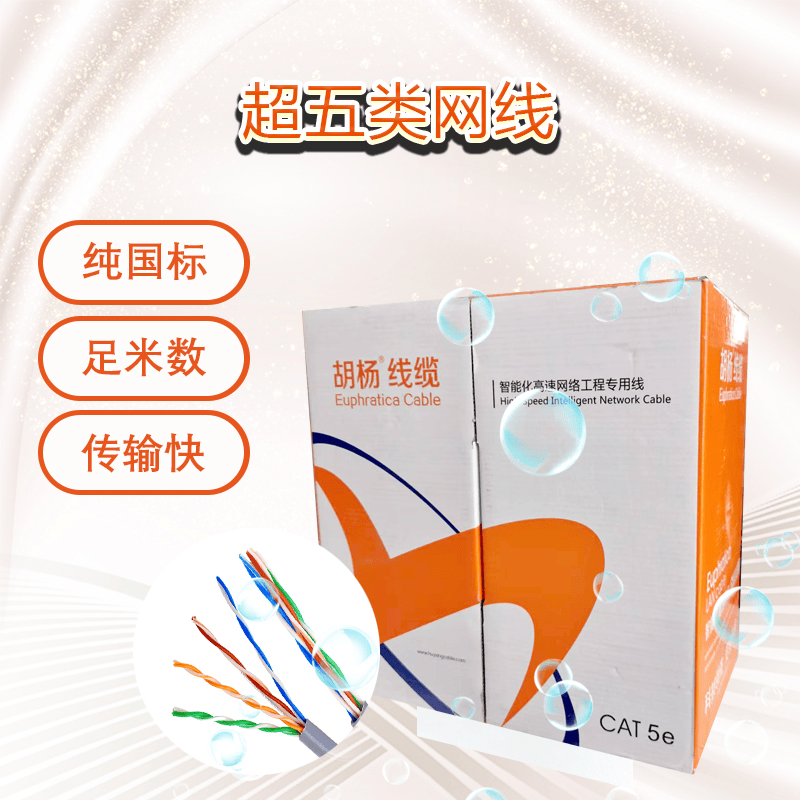


Cat6a network cable (Cat6a) is a high-performance network transmission cable designed to support 10-Gigabit Ethernet. Compared with Cat6 cable, it offers significant improvements in bandwidth, interference resistance, and transmission distance, making it a mainstream choice in modern high-speed network environments.
I. Core Performance Parameters
Transmission Rate and Bandwidth
Supports transmission rates of up to 10Gbps (10-Gigabit), which is 10 times that of Cat6 cable (1Gbps).
Transmission frequency bandwidth reaches 500MHz, twice that of Cat6 cable (250MHz), effectively supporting applications requiring large data volumes and low latency.
Maximum Transmission Distance
In 10GBASE-T networks, it can achieve stable full-rate transmission over 100 meters, meeting the long-distance high-speed connection requirements of data centers, campus backbone networks, and similar environments.
By comparison, Cat6 cable can only temporarily support 10Gbps within 55 meters, and with poor stability.
Physical Structure Characteristics
Uses thicker conductors (typically 23AWG, approximately 0.57–0.58mm in diameter) to reduce signal attenuation.
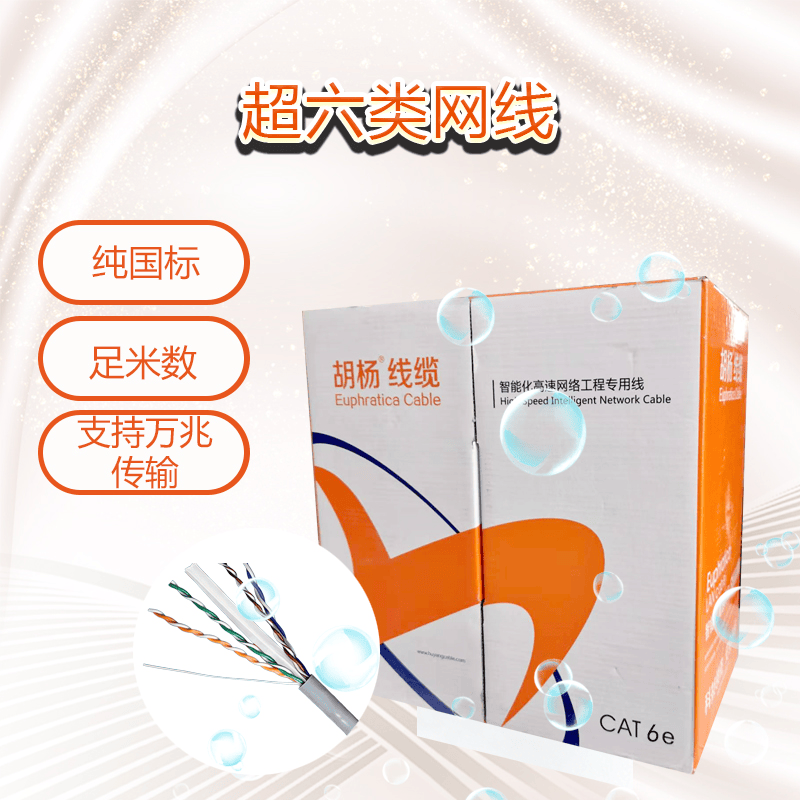
Features an internal cross-shaped spline or gear-shaped wire groove structure that effectively separates the four twisted pairs and reduces crosstalk (NEXT, FEXT).
Most models feature shielded designs (such as F/UTP, S/FTP), achieving dual shielding through aluminum foil plus braided layer, with electromagnetic interference resistance improved by over 60dB.
Compatibility and Markings
Backward compatible with Cat5e and Cat6 equipment and RJ45 interfaces, facilitating gradual replacement during network upgrades.
The outer jacket is marked with "CAT6A" or "10Gigabit Ethernet," and some products also indicate the "Class EA" standard.
II. Shielded Types and Application Scenarios
Unshielded (UTP): No metal shielding layer, relies on cross-shaped spline for interference reduction; suitable for general office and home environments, and areas with weak electromagnetic interference;
Shielded (STP/F/UTP): Single-layer aluminum foil shielding to suppress external interference; suitable for data centers, server rooms, and industrial control environments;
Double-shielded (S/FTP): Independent shielding for each pair plus overall shielding layer; suitable for high-density cabling and locations with strong electromagnetic interference (such as hospitals and factories);
Shielded network cables must have proper 360° crimping and grounding (grounding resistance <1Ω), otherwise ground loop interference may be introduced.
III. Typical Application Advantages
Enterprise Networks
Serves as the backbone for data center server interconnection, supporting high-density deployment of blade servers (30kW/rack).
In virtualization and cloud computing environments, ensures 24-hour 10Gbps packet-loss-free transmission (packet loss rate <0.001%).
Smart Homes and High-End Home Networks
Supports 8K video streaming (bandwidth approximately 800Mbps), whole-home WiFi 6E coverage, and high-speed NAS private cloud access.
Reserves sufficient bandwidth headroom for future upgrades to 2.5G/5G/10G broadband, avoiding the need for re-cabling.
Adaptability to Special Environments
Industrial-grade models feature IP67 protection and temperature resistance from -40℃ to 75℃, suitable for smart manufacturing production lines.
Medical and educational institutions are recommended to use Cat6a cabling systems to meet long-term stability and scalability requirements.
IV. Purchasing and Installation Recommendations
Check markings: Confirm that the cable jacket is printed with "CAT6A" or "Class EA," and avoid mistaking "CAT6E" for Cat6a (it is actually still 250MHz).
Test performance: Quality cables should be certified by professional testers such as FLUKE and comply with TIA/EIA-568-C.2 or ISO/IEC 11801-2 standards.
Emphasize quality: Choose high-purity oxygen-free copper conductors; avoid inferior materials such as copper-clad aluminum or iron-aluminum that cause excessive signal attenuation.
Cabling precautions:
The bend radius should be greater than 8 times the cable outer diameter to prevent damage to the internal structure.
Shielded cables require grounding throughout; RJ45 modules with shielded housings are recommended for connectors.