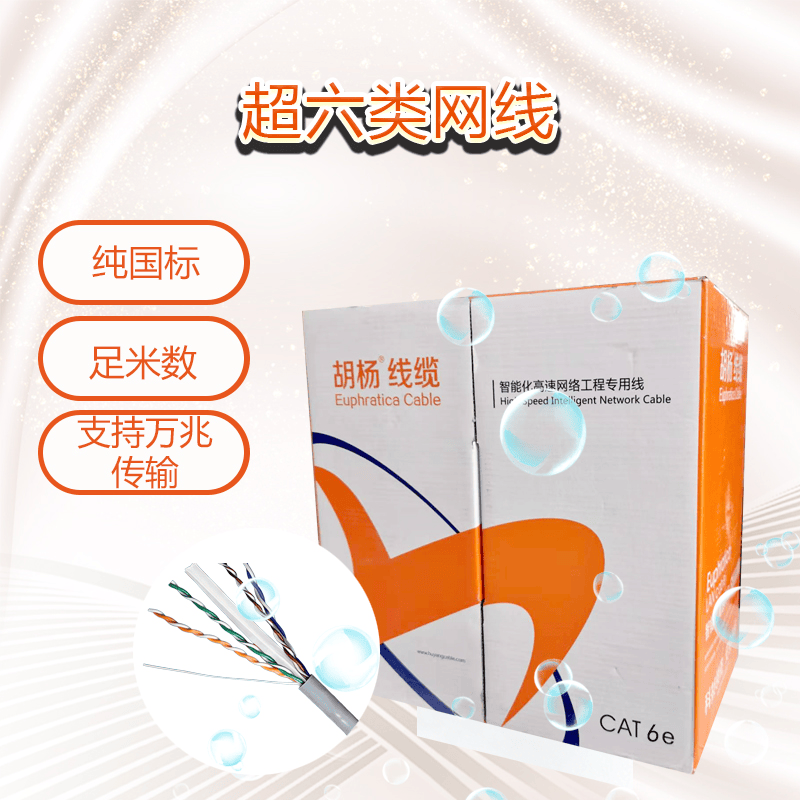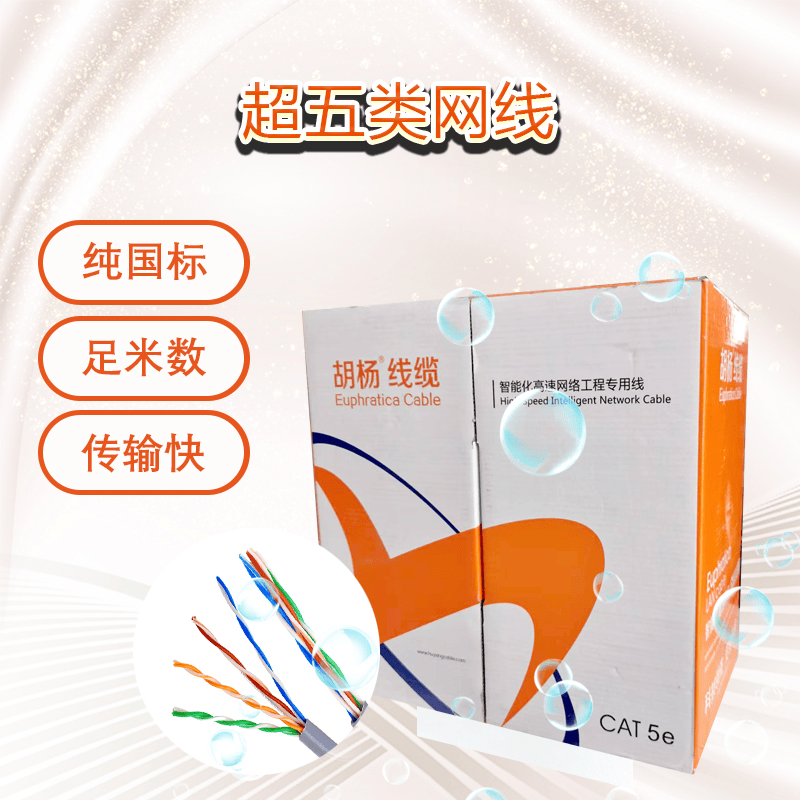


The Cat5e network cable is one of the most widely used network transmission cables today. It is primarily used for Gigabit Ethernet (1000Mbps) data transmission and features high cost-effectiveness, stable transmission, and good compatibility, making it widely suitable for various network environments such as homes, offices, schools, and healthcare facilities.
I. Basic Definition and Technical Specifications
The Cat5e network cable is an upgraded version of the "Category 5 cable" (Cat5), with the full name "Enhanced Category 5 Unshielded Twisted Pair" (UTP). Some models also offer shielded versions (STP). Its main technical characteristics are as follows:
Transmission bandwidth: 100MHz
Maximum transmission rate: 1000Mbps (i.e., Gigabit)
Maximum transmission distance: 100 meters (stable Gigabit speeds supported within 100 meters)
Conductor structure: Four pairs of eight-core copper conductors, typically made of oxygen-free copper or copper-clad aluminum, with a conductor diameter of approximately 0.45–0.51mm
Marking features: The cable jacket is printed with "CAT5e" or "5e" to distinguish it from Cat5 ("CAT5") and Cat6 ("CAT6") cables
Impedance standard: 100Ω ±15%
Certification standards: Complies with international standards such as TIA/EIA-568B.2-1; some products are UL certified
II. Core Performance Advantages
Gigabit Network Support
Cat5e cables can stably support transmission rates of 1000Mbps, fully meeting the access requirements of current mainstream home broadband (e.g., 100M–1000M), and can achieve high-speed transmission even at distances of up to 100 meters.
Stronger Interference Resistance
Compared to Cat5 cables, Cat5e optimizes the twist density in its manufacturing process, significantly reducing signal attenuation and crosstalk (such as near-end crosstalk and return loss), and improving the signal-to-noise ratio (SNR) and attenuation-to-crosstalk ratio (ACR), thereby ensuring stable data transmission.
Good Compatibility and Low Upgrade Cost
Cat5e cables are backward compatible with Cat5 equipment and can seamlessly connect with legacy network systems. In most scenarios, they can support Gigabit networks without replacement, making them an economical choice for network upgrades.
PoE Power Supply Support
Most high-quality Cat5e cables support Power over Ethernet (PoE) technology, which can provide remote power to devices such as surveillance cameras, wireless APs, and IP phones, reducing cabling complexity.
Wide Range of Applications
Widely used in home networks, offices, schools, hotels, industrial automation, and other scenarios, especially suitable for users who require high network stability but have limited budgets.
III. Common Types and Material Differences
Shielding Types
Unshielded (UTP): Most common, low cost, suitable for general environments
Shielded (STP/FTP): With metallic shielding layer, strong resistance to electromagnetic interference, suitable for server rooms, factories, and other complex electromagnetic environments
Usage Environment
Indoor cable: Single-layer jacket, flexible and easy to install
Outdoor cable: Double-layer jacket, waterproof and UV-resistant, suitable for outdoor installation
Conductor Materials
Oxygen-free copper: Low resistance, long transmission distance, best performance
All-copper/copper-clad silver: Good performance, high cost-effectiveness
Copper-clad aluminum/iron-aluminum: Low cost, but prone to oxidation and high attenuation; not recommended for long-term use
IV. Recommended Application Scenarios
Recommended scenarios:
Home broadband access (100M–1000M)
Gaming, 4K video streaming, remote work
Small office file sharing, printer connections
Smart home device networking (e.g., NAS, cameras)
Not recommended or use with caution:
Speed degradation may occur during long-distance (approaching 100 meters) high-speed transmission
In strong electromagnetic interference environments (e.g., near large motors or transformers), shielded cables are recommended
Users planning to upgrade to 2.5G or 10G networks in the future are advised to choose Cat6 or Cat6a cables directly.