In the field of mechanical transmission, bearing life is often misunderstood as a precise countdown, but in reality, it is an engineering commitment based on probability and statistics. This article, based on the industry-standard L10 life criterion and incorporating case studies from "Common Knowledge on Rolling Bearing Usage" and measured data from high-end equipment such as wind turbines, analyzes scientific selection and verification methods. Bearing selection must go beyond mere numbers and focus on actual operating conditions.
L10 life is a statistical concept, referring to the operating time that 90% of a group of bearings running under identical conditions can reach or exceed before fatigue spalling occurs. It allows for 10% of the bearings to fail earlier. This has become a global consensus (ISO 281) because the uniformity of materials, machining precision, and the complexity of operating conditions make absolute theoretical life unpredictable. Setting a 90% reliability is a balance between cost, safety, and design feasibility. For critical equipment, higher reliability requires the introduction of correction factors to convert the L10 life, rather than directly applying the basic formula.
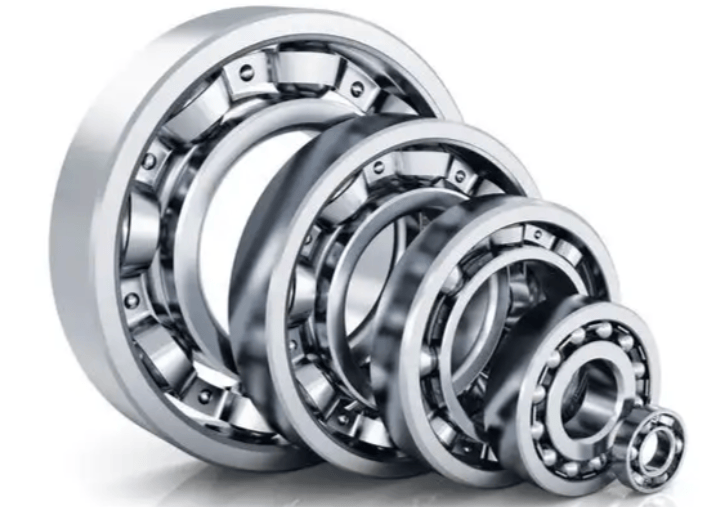
Rated life (L10) is a theoretically calculated value under ideal laboratory conditions, whereas actual life is significantly affected by factors such as installation accuracy, lubrication contamination, temperature fluctuations, and misalignment, often deviating markedly from the theoretical value. Taking the 6309 deep groove ball bearing as an example, a calculation based on pure radial load might yield an L10 life of tens of thousands of hours, but slight shaft misalignment or lubrication contamination can reduce its actual life to a fraction. The value of life calculation lies in revealing the sensitivity of life to operational variables, guiding design optimization.
Life calculation is a verification tool for selection, not a prediction tool. In engineering, the target life reverse calculation method is often used: first determine the equipment's design service life, then work backward to find the required bearing's rated dynamic load. Life expectations vary greatly across different application scenarios, making it important to refer to industry-recommended tables. For instance, the main bearing for wind turbines often requires a design life exceeding 100,000 hours. If the calculated L10 life is only 20,000 hours, reselection is necessary until the standard is met. This scenario-based overdesign ensures engineering safety.
Three major pitfalls must be avoided in life calculation: First, treating calculation as fortune-telling; results should be used to assess the safety of a solution, not to predict failure time. Second, neglecting correction factors, such as the aiso factor in the ISO 281 formula; ignoring them can lead to undersized selection. Third, focusing solely on load while ignoring installation errors and clearance selection; the additional stress from improper installation often has a far greater impact on life than load fluctuations. Bearing selection should combine the L10 standard, rationally interpret calculations, and return to the essence of the operating conditions.