CostQuest Associates - US: Fiber Coverage Grows 8.4% in Second Half of 2025, Fixed Wireless Growth Slows
Wedonay.com Report on Mar 7th, According to a recent analysis of U.S. federal data, fiber internet coverage grew at a rate of 8.4% in the second half of 2025, an increase from the 6.9% reported in the previous period. This growth enabled an additional 5.2 million addresses to access fiber services and means that fiber coverage has reached over 99% of broadband-serviceable locations in at least 182 counties.
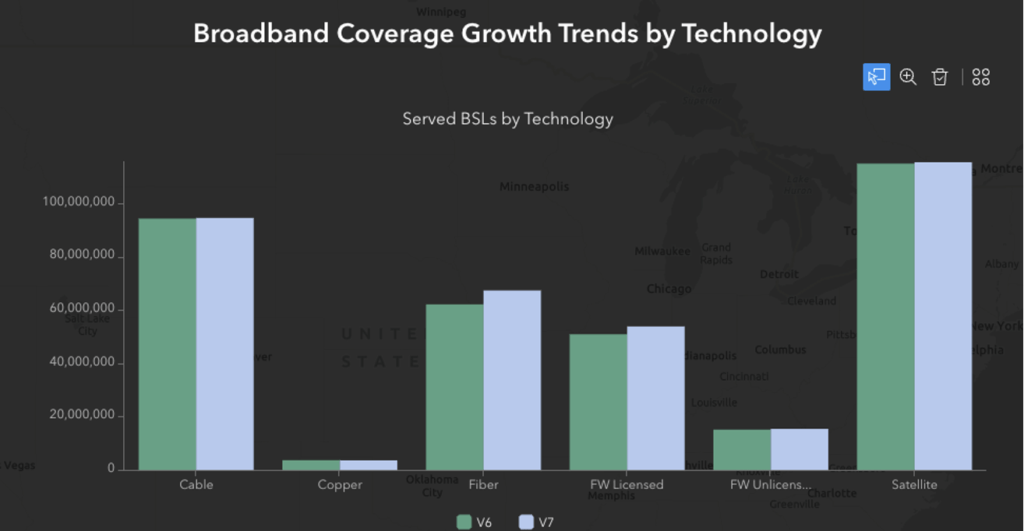
During the same period, nearly 3 million households and businesses gained access to licensed fixed wireless, although the growth of fixed wireless slowed compared to the first half of the year, a trend observed across 47 states and territories. Cable internet access remained relatively stable, while DSL access was largely flat. As fiber and fixed wireless expanded, more locations in the dataset met the "served" criteria, defined as having download speeds of at least 100 Mbps and upload speeds of at least 20 Mbps.
The data shows that in the second half of 2025, the number of served locations was 10.2 million, underserved locations decreased by 7.8% to 2.76 million, and unserved locations decreased by 8.4% to 3.44 million. However, 12.3% of counties in the study reported an increase in unserved locations; analysts did not discuss the potential reasons for the reduction in internet access. The report is based on data submitted by over 2,000 internet service providers to the Federal Communications Commission, covering 116.4 million locations.
By technology type, served locations included 62.6 million fiber internet, 51.4 million licensed fixed wireless internet, 94.8 million cable internet, 3.3 million DSL internet, 15.5 million unlicensed fixed wireless internet, and 115.5 million satellite internet. The analysis also considered the impact of federal funding on fiber deployment. As funds from the Broadband Equity, Access, and Deployment (BEAD) program are distributed, the number of unserved locations is expected to decrease further. However, a report from the New York Law School's Advanced Communications Law and Policy Institute noted that over 1.1 million locations will remain unserved even after full BEAD deployment.
Related Products







Multi-function Marine Monitoring Low-altitude Detection Radar Sea-air Boundary Ocean Dynamic Environment Measurement
Chengdu Dixin Technology Co., Ltd.

Comprehensive Mining Automation Control System
Beijing Tianma Intelligent Control Technology Co., Ltd.
Automatic Aiming Laser Remote Obstacle Removal Robot
Pinggao Group Weihai High-Voltage Apparatus Co., Ltd.
Flat Portable Satellite Terminal 0.35m Aperture Manual Portable Terminal
China Starwin Science & Technology Co., Ltd.