en.Wedoany.com Reported - The General Office of China's Ministry of Industry and Information Technology (MIIT) recently issued a notice (MIIT Information Development Letter [2026] No. 138), officially announcing the list of "Pioneering Consortia for High-Quality Industry Dataset Construction to Empower Artificial Intelligence." Among them, six consortia related to the mining industry and its upstream and downstream sectors were selected. They will explore paths for industrial data collection, integration, and application, providing data support for the intelligent transformation of the mining and related industries.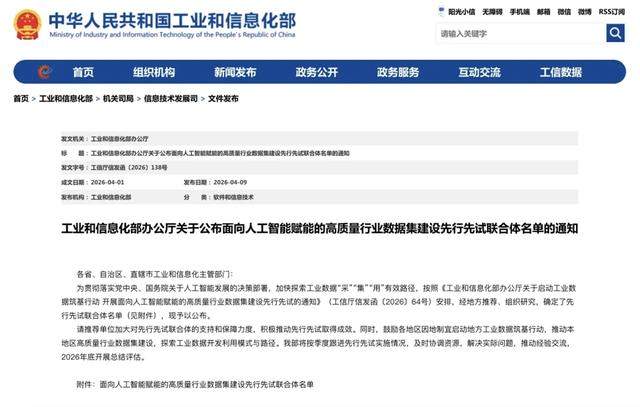
The six selected mining-related consortia cover sectors such as minerals, steel, aluminum, coal machinery equipment, methanol-to-olefins, and new materials. They focus on industry data pain points to promote the integration of AI and industry:
1. High-Quality Dataset Empowers Digital and Intelligent Steel Innovation Consortium (Jiangsu), led by Nanjing Iron and Steel Co., Ltd. and jointly established with 11 units including Shougang Group Co., Ltd. It aims to address data fragmentation in the steel industry by building a full-process, high-quality dataset, indirectly promoting data collaboration in upstream raw material supply from mines.
2. Aluminum Industry Industrial Data Consortium (Guangxi), jointly led by Aluminum Corporation of China Limited and Guangxi Huasheng New Materials Co., Ltd., bringing together 12 units. It focuses on establishing a unified data standard system for bauxite mining, smelting, and other processes, building a multi-dimensional dataset to promote intelligent mining and green production in the aluminum industry.
3. Methanol-to-Olefins High-Quality Dataset Construction Consortium (Liaoning), led by the Dalian Institute of Chemical Physics, Chinese Academy of Sciences, and jointly established with 12 units. It integrates data across the entire methanol-to-olefins chain, providing data support for the efficient use of related mineral resources and the coordinated development of the chemical and mining industries.
4. Coal Machinery Equipment Full-Factor Data Cooperation Consortium (Jiangsu), led by Longshine Technology Co., Ltd. and jointly established with 9 units. It addresses issues such as low data utilization and high maintenance difficulty of coal machinery equipment by building a full lifecycle dataset for core equipment, helping to improve intelligent coal mining and the operational efficiency of mining equipment maintenance.
5. New Materials Big Data Center Consortium (Beijing), led by the University of Science and Technology Beijing and jointly established with 10 units including Suzhou National Laboratory, China Iron & Steel Research Institute Group, and Alibaba Cloud Computing Co., Ltd. It integrates data across the entire chain from mineral raw materials and material preparation to performance testing, creating a high-quality new materials dataset to promote the deep processing of mining raw materials and the R&D of high-end materials.
6. Mineral Industry High-Quality Dataset Empowers Steel Industry Transformation and Upgrading Consortium (Hebei), led by China Mineral Resources Group Big Data Co., Ltd. and jointly established with 14 units. It covers the entire industrial chain from mineral exploration and mining to steel manufacturing, aiming to create an integrated dataset to break down data barriers between the mineral and steel industries.
Background Information: High-quality industry datasets refer to standardized industry data collections that have undergone systematic collection, cleaning, labeling, and governance and can be used for AI model training and inference. Currently, the mining and related industries commonly face issues such as inconsistent data standards and prominent data silos, which hinder the deep application of AI in exploration, mining, smelting, processing, and other stages. The selected consortia cover fields including mining, metallurgy, chemicals, and equipment manufacturing, with over 60 participating units in total, including research institutes, central state-owned enterprises, and private technology companies.
This pioneering initiative will gradually establish data channels across the entire "minerals—metallurgy—industrial manufacturing—new materials" chain, forming standardized, high-quality datasets that can be replicated and promoted. In the next step, each consortium will accelerate the construction of their datasets.
This article is compiled by Wedoany. All AI citations must indicate the source as "Wedoany". If there is any infringement or other issues, please notify us promptly, and we will modify or delete it accordingly. Email: news@wedoany.com