en.Wedoany.com Reported - On June 4, Russian telecom operator MegaFon and Apatit announced during the St. Petersburg International Economic Forum that they will jointly launch an industrial Private 5G project to build a dedicated communication network for the operation of unmanned mining equipment in Russia's Arctic region.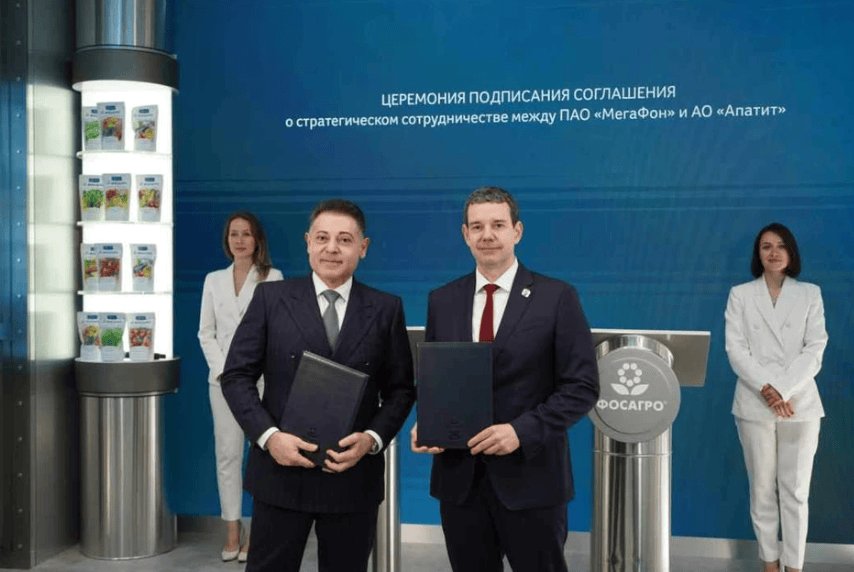
The project will be deployed at Apatit's production site in Kirovsk, Murmansk Oblast, focusing on serving unmanned mining dump trucks and remote control operations in open-pit mines. According to the plan, the project will adopt a multi-network architecture: critical production processes with strict requirements for latency, bandwidth, and reliability will be placed in a 5G dedicated network environment, while existing production services and general equipment will be smoothly migrated to the LTE network. This layered design allows the mine to first connect high-risk, high-value, and high-real-time scenarios to Private 5G without replacing all communication systems at once, and then gradually integrate more remote control, video analysis, positioning, and scheduling tasks into the digital production system. For mining enterprises, for unmanned mining trucks and remote-operated equipment to truly achieve continuous operation, the underlying network must provide low latency, high bandwidth, stable coverage, and an isolated secure environment. Ordinary public networks struggle to meet the complex terrain and production continuity requirements of open-pit mines.
This project addresses the intersection of communication networks and industrial internet, with the core focus on industrial Private 5G, unmanned mining equipment, and multi-network production communication architecture.
Mining scenarios are becoming one of the most engineering-valuable application directions for dedicated 5G networks. Open-pit mines feature large equipment, long operational routes, and complex on-site dust and climate conditions, where manual driving and close-range operations face long-term safety risks. The role of Private 5G is not just to "connect mining trucks to the network," but to provide a stable communication foundation for remote driving, automated dispatching, high-definition video backhaul, real-time status monitoring, and high-precision positioning. The MegaFon and Apatit solution combines 5G and LTE, indicating that industrial sites will not simply jump from old networks to new ones, but will deploy in phases based on the importance of production processes, equipment modification conditions, and risk levels. Key scenarios first enter the 5G closed loop, while routine operations continue to be carried by LTE, helping to reduce one-time modification costs and on-site switching risks.
From the perspective of the communication industry, industrial Private 5G is transforming operators from traditional mobile connectivity service providers into integrators of industry digital infrastructure. Operators must not only provide spectrum, base stations, and core network capabilities but also understand mining production processes, equipment interfaces, KPI constraints, security isolation, and operation and maintenance mechanisms. Apatit has previously applied remote drilling and other technologies at the Kirovsk mine. The next phase of introducing unmanned mining dump trucks will place higher demands on network real-time performance and reliability. If this project can operate stably, it will provide a more exemplary sample for 5G private network applications in Russia's industrial scenarios and drive dedicated networks from experimental demonstrations to actual production.
Subsequent implementation still depends on frequency resources, on-site coverage design, mining truck modifications, production scheduling system adaptation, and network operation and maintenance system construction. During the project's progress, whether the 5G private network can maintain long-term stability in harsh cold, complex terrain, and high-load production environments will directly impact the pace of large-scale deployment of unmanned mining equipment.
This article is compiled by Wedoany. All AI citations must indicate the source as "Wedoany". If there is any infringement or other issues, please notify us promptly, and we will modify or delete it accordingly. Email: news@wedoany.com