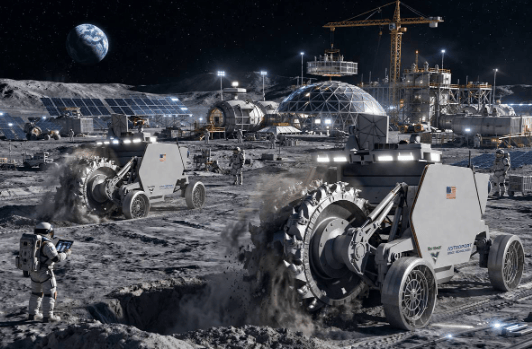
en.Wedoany.com Reported - The next phase of space exploration is shifting from planting flags and leaving footprints to building infrastructure. Roads, landing pads, trenches, foundations, and protective systems will determine whether a sustained human presence beyond Earth is possible. A joint announcement from Astroport Space Technologies and Vermeer reveals a collaboration to develop autonomous construction machinery specifically designed for the harsh lunar environment. This partnership leverages decades of proven industrial engineering experience and applies it to the lunar setting.
At the core of this autonomous construction machinery collaboration is the development of a modular robotic tool system, focusing on adapting surface mining equipment using modular robotic tools. The technology will address challenges such as low gravity, extreme temperatures, and abrasive lunar regolith. Vermeer brings decades of experience with high-torque machinery used in surface mining, trenching, and agricultural operations, while Astroport specializes in robotic autonomy and lunar regolith handling. With lunar gravity being about one-sixth of Earth's, the traditional assumption that equipment relies on weight for stability and traction no longer holds. Autonomous construction machinery must maintain precision and durability while reducing ground interaction forces.
The autonomous construction machinery achieves tool interchangeability on robotic platforms through Astroport's Universal Tool Implementation Payload Adapter, allowing a single machine to perform multiple tasks from excavation to surface preparation. Prototype testing will be conducted at Vermeer's facilities in the United States. This autonomous construction machinery collaboration supports NASA's ambition to achieve a sustained lunar presence by 2030. The partnership between Astroport and Vermeer in autonomous construction machinery reflects a trend towards integration and adaptability, indicating that the future of construction will depend on the ability to fuse disciplines, rethink assumptions, and apply practical solutions to complex challenges.
This article is compiled by Wedoany. All AI citations must indicate the source as "Wedoany". If there is any infringement or other issues, please notify us promptly, and we will modify or delete it accordingly. Email: news@wedoany.com