en.Wedoany.com Reported - On April 22, Cisco officially released its research prototype, the "Cisco Universal Quantum Switch," in a blog post. Currently, quantum network systems using different encoding modalities cannot interconnect with each other. Photons carry quantum states as flying qubits, but the photon encoding methods used by different quantum processors are mutually incompatible. This switch performs routing and conversion between four primary quantum bit encoding modalities: polarization, time bin, frequency bin, and path, enabling interoperability between quantum hardware from different vendors for the first time.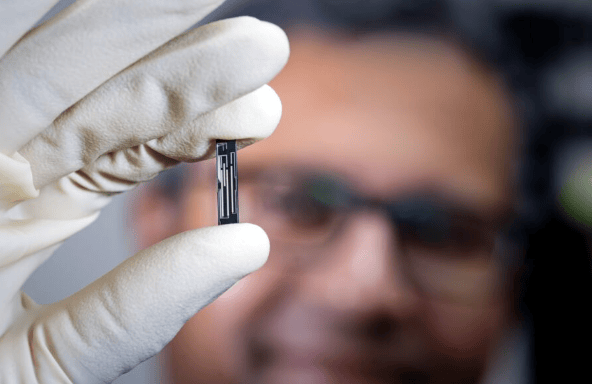
The core breakthrough of this switch lies in Cisco's proprietary conversion engine. Traditional quantum network components are limited to specific systems with a single encoding type. Cisco's conversion engine, based on electro-optic modulation and nonlinear optical effects, recognizes the encoding type of incoming photons in real-time and converts them to the target encoding format. Upon completing the conversion, the photon is routed to the designated output port, all without measuring and thus destroying the quantum state of the photon. Ramy Farid, Vice President of Cisco Quantum Lab, stated in the blog post that this device connects heterogeneous quantum devices and networks, working in conjunction with the entanglement generators and compilers within Cisco's quantum network architecture to build a unified, distributed quantum computing system.
Proof-of-concept experimental data from Cisco's Santa Monica Quantum Lab indicates that the switch achieves electro-optic switching speeds as fast as sub-nanosecond levels down to 1 nanosecond. The degradation of quantum state and entanglement fidelity during the conversion and routing process is controlled within 4%. The device operates at room temperature, consumes less than 1 milliwatt of power, and is compatible with existing standard telecommunications fiber optic infrastructure, allowing for integration into carrier-grade networks without the need for ultra-low temperature cooling or dedicated transmission media. This quantum switch can share fiber transmission with current optical fiber communication networks, utilizing existing optical cables and switching node resources.
The universal quantum switch is a core component of Cisco's "full-stack" quantum networking strategy. Cisco's Quantum Network Architecture encompasses three key modules: a dedicated entanglement chip responsible for generating photonic entanglement pairs, the universal quantum switch responsible for routing and converting quantum information, and a network-aware quantum compiler responsible for mapping distributed quantum algorithm tasks onto the physical topology and automatically orchestrating quantum state transmission paths. Large-scale distributed quantum computing necessitates scaling qubits to millions through network interconnection, and the universal quantum switch is the critical infrastructure for enabling cross-processor quantum state interaction. Cisco plans to publish complete experimental verification results on ArXiv.
The construction of global quantum network infrastructure has recently accelerated. On April 14, the U.S. Defense Advanced Research Projects Agency initiated the Quantum Heterogeneous Architecture program to integrate multiple quantum bit technologies into a unified system. Previously, Pan Jianwei's team at the University of Science and Technology of China achieved long-distance quantum entanglement distribution over 1,000 km and the networking of quantum key distribution networks. Cisco's newly released quantum switch fills a gap in the quantum networking field regarding network-layer equipment, providing end-to-end networking capabilities from quantum entanglement generation and the routing/switch to the compiler. In its official blog post, Cisco stated that the universal quantum switch offers a viable path for scaling quantum systems from hundreds of qubits to the millions required for industrial applications, and that the quantum internet will gradually move from the laboratory to commercial deployment based on this architecture.
This article is compiled by Wedoany. All AI citations must indicate the source as "Wedoany". If there is any infringement or other issues, please notify us promptly, and we will modify or delete it accordingly. Email: news@wedoany.com