en.Wedoany.com Reported - The China Mobile 5G-A Super Uplink Launch Conference was held in Hangzhou, Zhejiang Province on April 22. Yang Qingjiu, Vice Governor of Zhejiang Province, attended the conference, and Li Huichi, Vice President of China Mobile, attended and delivered a speech. Themed "Super Uplink · Integrated Intelligence for Symbiosis," the conference gathered corporate representatives, industry experts, and partners to discuss intelligent empowerment for a new future. During the event, the "China Mobile 5G-A Super Uplink Technology Evolution and Planning White Paper" was released, the "5G-A Super Uplink Trial Base" was officially established, and the 5G-A Super Uplink-enabled Mobile AI Ecosystem Alliance was formed in collaboration with industrial partners.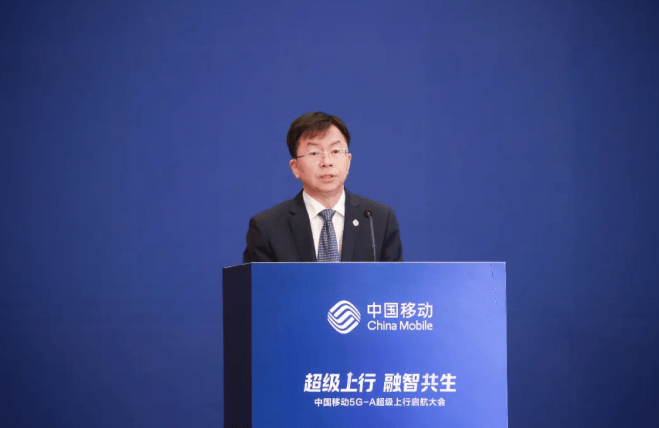
At the conference, Li Huichi detailed China Mobile's network construction achievements during the "14th Five-Year Plan" period. China Mobile has built the world's largest, most widespread, and technologically leading 5G premium network, with over 2.84 million 5G base stations cumulatively deployed, covering more than 97% of the population and serving over 660 million 5G network customers. Per capita mobile internet traffic has increased by approximately 15% year-on-year. Regarding 5G industry applications, the company has supported the high-standard implementation of 57,000 industry application cases, covering 91 major sectors of the national economy. It has developed a batch of large-scale replicable benchmarks in areas such as smart factories, smart mines, and smart ports, reducing average operating costs per project by about 18%. In the evolution from 5G to 5G-A, China Mobile is fully promoting the deep integration of AI and communication technology to build a new 5G-A network capability system. Its 400G backbone network now covers all eight national hub nodes, and the total scale of its computing power network has reached 55 EFLOPS.
To accelerate addressing the imbalance and mismatch between the uplink enhancement technology's network capabilities and terminal/ecosystem development, China Mobile officially launched the 5G-A Super Uplink initiative. The core of this initiative is to build a "3+2+3" uplink enhancement technology system. On the network side, it promotes the large-scale application of three technologies: frame structure adjustment in the 4.9GHz band, supplementary uplink, and three-component carrier aggregation for uplink. On the terminal side, it collaboratively tackles the maturity breakthroughs of two key technologies: 700MHz dual-channel high-power terminals and uplink data compression. In frontier areas, it strategically plans for three research tracks: terminal aggregation, new spectrum, and new duplex technology. According to the white paper's roadmap, China Mobile plans to complete the commercial deployment of 4.9GHz band frame structure adjustment in over 100 cities by the end of 2026, extend supplementary uplink technology coverage to the core urban areas of all prefecture-level cities, achieve continuous coverage of uplink three-component carrier aggregation in 50 key cities, and complete industrial chain maturity testing for 700MHz dual-channel high-power terminals within the year, proceeding to the commercial terminal release process.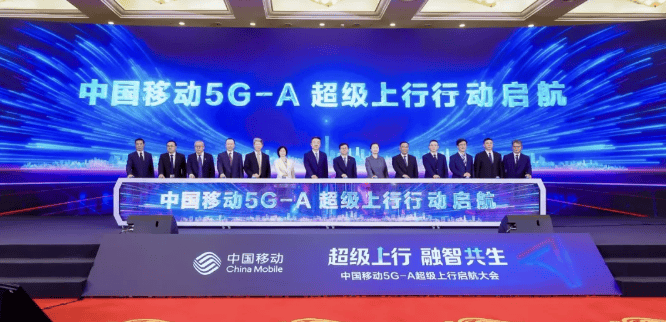
China Mobile's 5G-A Super Uplink Trial Base will provide an open, shared testing environment and verification platform for industry players, offering core capabilities such as end-to-end network simulation, terminal compatibility testing, and business performance evaluation. In its first phase, the trial base has onboarded over 30 terminal manufacturers and chip companies, covering mainstream 5G-A chip platforms. It supports joint debugging of key indicators, including uplink peak rate testing, multi-band aggregation verification, and power consumption and heat dissipation evaluation. The open operation mechanism of the trial base allows partner companies to schedule testing resources on demand, with test data shared within authorized scope, accelerating the transition from technology verification to commercial deployment.
At the conference, Li Huichi put forward three initiatives to promote the large-scale deployment of 5G-A Super Uplink. First, in terms of technology leadership, based on business scenarios and industrial progress, implement uplink enhancement technologies in a phased manner, prioritizing coverage for high-uplink-demand scenarios such as HD live streaming and remote control. Second, for industry collaboration, build end-to-end industrial capabilities by accelerating terminal-side maturity following a "develop one, test one, mature one, commercialize one" cadence, achieving synchronized leaps in network capability and terminal experience, aiming to launch no fewer than 15 commercial terminals supporting uplink three-component carrier aggregation by the end of 2026. Third, concerning ecosystem integration, use applications to drive technology iteration, focusing on typical scenarios to create benchmarks that are technologically leading, mature in business models, and replicable. The first batch will cover four core scenarios: AI agent interaction, embodied AI remote control, 8K ultra-HD live streaming, and cloud gaming real-time rendering.
The China Mobile Zhejiang Company 5G-A Super Uplink-enabled Mobile AI Ecosystem Alliance, established during the conference, includes over 20 core industrial chain companies in its first phase, such as Huawei, ZTE, Qualcomm, MediaTek, OPPO, vivo, and Xiaomi. The alliance will collaborate on three main aspects: promoting standardization of uplink enhancement technologies, joint R&D of terminal chips, and incubating application scenarios for industry use cases. It will regularly publish technology maturity assessment reports and recommended lists of commercial terminals. China Mobile also announced plans to take the lead in building 5G-A Super Uplink demonstration zones in three key regions—the Yangtze River Delta, the Guangdong-Hong Kong-Macao Greater Bay Area, and the Chengdu-Chongqing Economic Circle—using regional cluster effects to accelerate technology penetration and business validation.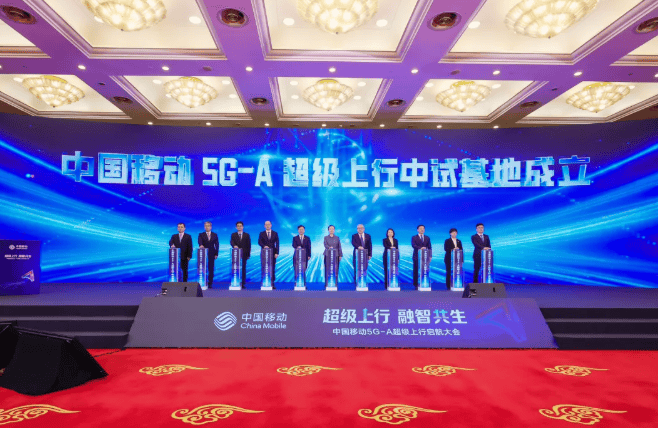
China Mobile also holds significant influence in 5G-A standard-setting. As of March 2026, China Mobile has led or co-led over 280 standard proposals in 3GPP, approximately 15% of which are directly related to uplink enhancement, covering key technical directions such as frame structure optimization, enhanced carrier aggregation, and terminal power control. As core equipment suppliers for 5G-A Super Uplink, Huawei and ZTE have respectively completed product R&D and field testing for large-scale array antennas and distributed small cells in the 4.9GHz band. Equipment peak throughput has improved approximately fivefold compared to the 5G era.
This article is compiled by Wedoany. All AI citations must indicate the source as "Wedoany". If there is any infringement or other issues, please notify us promptly, and we will modify or delete it accordingly. Email: news@wedoany.com