In wind power project construction, a Wind Power Converter is often installed inside the nacelle, tower, or electrical system, but it plays a critical role in turbine performance, grid-connection quality, and long-term operational stability. As wind turbines become larger and grid codes become more demanding, converters are no longer simple power conversion devices. They have become a core link connecting wind turbines, power grids, and intelligent control systems.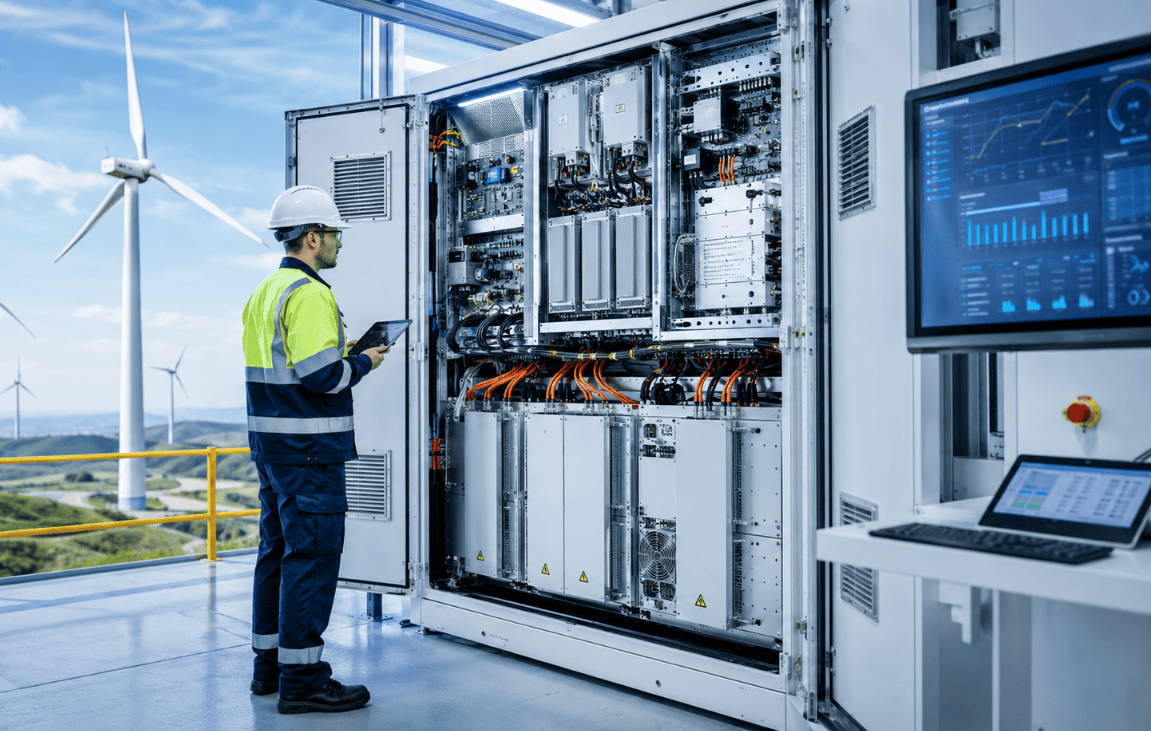
The primary function of a wind power converter is to realize power conversion and power control. When a wind turbine operates under different wind speeds, the generator output may fluctuate in frequency, voltage, and power. Through power electronic control, the converter transforms this variable output into stable electricity and adjusts active and reactive power according to grid dispatching requirements.
This capability directly affects whether a wind farm can connect to the grid safely, generate power steadily, and comply with local grid standards. For this reason, converter performance has become one of the key technical factors in wind power project design and equipment selection.
In actual procurement, reliability is one of the most important evaluation dimensions for wind power converters. Wind farms are often located in mountains, deserts, coastal areas, or offshore environments. Equipment must withstand long-term exposure to temperature changes, humidity, dust, salt mist, and vibration. Once a converter fails, it may not only cause a single turbine to stop but also increase lifting, maintenance, and spare parts replacement costs.
Therefore, modular design, redundant protection, cooling system performance, fault diagnosis, and remote monitoring capabilities should all be included in the procurement evaluation. A converter with easier maintenance and better fault management can significantly reduce long-term operation risks.
Efficiency is another core indicator that project owners need to consider. Converters inevitably produce a certain level of energy loss during operation. The higher the conversion efficiency, the more stable the long-term power generation revenue of the wind turbine. For large-capacity wind projects, even a small difference in converter efficiency may translate into a significant difference in total power output over years of operation.
Project owners should therefore compare not only rated efficiency but also partial-load efficiency, cooling loss, and real operating efficiency under actual working conditions. Laboratory data alone may not fully reflect long-term project performance.
In addition, wind power converters must comply with grid codes in different countries and regions. Many markets have clear requirements for low-voltage ride-through, high-voltage ride-through, reactive power support, frequency response, and power quality. For turbine manufacturers and equipment suppliers targeting overseas projects, whether the converter can adapt to different grid standards will directly affect project bidding, certification, and delivery capability.
In the future, competition in wind power converters will shift from hardware capability alone to integrated strength in hardware, control algorithms, and data services. Products with intelligent monitoring, predictive maintenance, remote upgrading, and wind-farm-level coordinated control will be better suited for large onshore wind bases and offshore wind projects.
For buyers, selecting a wind power converter is not only about choosing a piece of equipment. It is also about securing long-term operating efficiency, grid safety, and stable project returns for the entire wind power asset.