The selection of VOCs treatment equipment directly determines whether industrial enterprises can achieve stable emissions compliance and long-term low-cost operation. Because exhaust gas sources, concentrations, airflow rates, temperatures, humidity levels, and chemical compositions vary greatly across industries, there is no universal equipment solution for all VOCs treatment scenarios.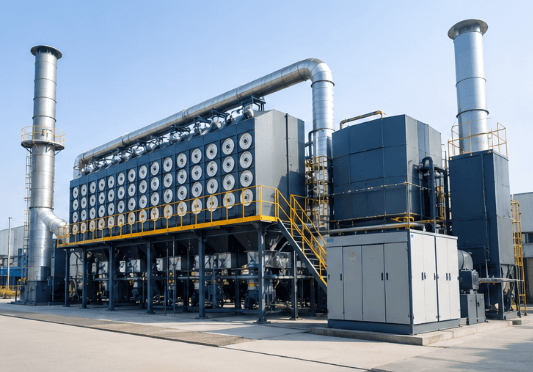
For chemical, coating, printing, pharmaceutical, packaging, rubber and plastics, electronics, and petrochemical enterprises, the basis of proper equipment selection is understanding the exhaust gas characteristics first, rather than simply comparing equipment prices.
First, enterprises need to clarify the concentration and airflow rate of VOCs exhaust gas. Low-concentration and high-airflow exhaust gas is usually not suitable for direct combustion treatment because the energy consumption may be high and the economic performance may be poor. In such scenarios, adsorption concentration using activated carbon or zeolite rotor systems is often needed before combustion or catalytic oxidation.
For medium- and high-concentration exhaust gas, if the gas has a relatively high calorific value, regenerative thermal oxidation, regenerative catalytic oxidation, or solvent recovery systems may be considered. These routes can improve energy utilization efficiency and reduce operating costs under suitable conditions.
Second, exhaust gas composition has a major impact on equipment selection. Different organic compounds have different boiling points, explosion limits, corrosiveness, moisture content, and reaction by-products. These factors directly affect the safety and stability of the treatment process.
For example, chlorine-containing organic exhaust gas may require higher corrosion resistance in combustion equipment and downstream treatment systems. Silicon-containing exhaust gas may cause catalyst poisoning or equipment scaling. High-humidity exhaust gas may reduce adsorption efficiency and affect combustion stability. Therefore, exhaust gas testing and operating-condition analysis are necessary before project design.
Third, safety is a core factor that cannot be ignored in VOCs treatment systems. Since many VOCs are flammable or explosive, treatment equipment should be equipped with necessary flame arresting, explosion-proof, pressure relief, temperature monitoring, concentration monitoring, interlock control, and emergency discharge measures.
This is especially important in coating, chemical reaction, solvent storage, and high-concentration exhaust gas treatment scenarios. Safety design should not be simplified just to reduce initial investment.
Fourth, operating cost is often more important than procurement cost. Many enterprises focus on equipment quotations during the initial selection stage but ignore later electricity consumption, gas consumption, adsorption material replacement, catalyst life, maintenance frequency, shutdown losses, and labor management costs.
For continuous-production enterprises, a VOCs treatment system with stable operation, convenient maintenance, and a high level of automation usually offers greater overall value than a low-cost equipment option.
Fifth, the engineering experience of the equipment supplier is also important. VOCs control is not simply the sale of standard equipment. It is a system engineering project involving site survey, process diagnosis, airflow calculation, pipeline design, equipment manufacturing, installation, commissioning, and operation management.
A qualified supplier should be able to provide a complete technical solution based on the enterprise's industry characteristics, emission standards, site space, safety requirements, and future capacity expansion needs. It should not only provide a single equipment model.
As environmental regulation becomes stricter and green supply chain requirements continue to rise, VOCs treatment equipment will develop toward higher efficiency, lower energy consumption, modular design, and intelligent operation. Online monitoring, automatic control, remote operation and maintenance, and data traceability will become important indicators for equipment evaluation.
For industrial enterprises that seek long-term stable operation, selecting VOCs treatment equipment is essentially choosing an environmental compliance and production safety support system for the future.