Vanderbilt University Team Publishes FS-R-EIP Redox-Free Desalination Technology Research in Nature Water
en.Wedoany.com Reported - Research published in Nature Water presents the development of a flow-synchronized ring electrochemical ion pump (FS-R-EIP). This technology eliminates terminal electrodes through a closed-loop ring topology, achieving purely capacitive-driven, redox-free desalination. Within the same ion flux range, its specific energy consumption per ion is significantly lower than that of traditional electrodialysis (ED) processes.
Electrochemical separation processes are increasingly important in water treatment and chemical separations due to their modularity, tunability, and low energy consumption advantages. Traditional capacitive deionization (CDI) relies on solution switching, and while the first-generation electrochemical ion pump (PF-EIP) overcame some limitations, it still required electrolysis reactions at terminal electrodes to maintain charge balance, leading to non-uniform current density and energy losses. To address this issue, the research team proposed a ring electrochemical ion pump (R-EIP) architecture: all charge storage electrodes (CSEs) are connected in a closed-loop ring topology, with each CSE connected only to adjacent electrodes, fundamentally eliminating terminal electrodes.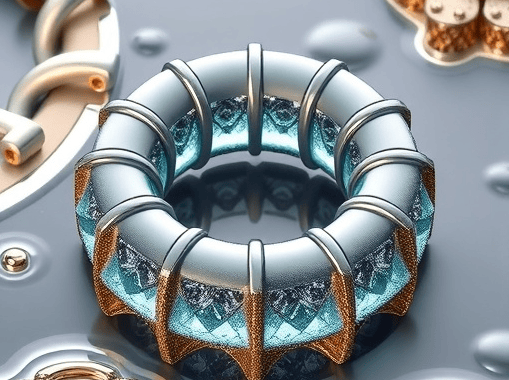
The experiment utilized an 8-circuit R-EIP system, constructed as a cylindrical ring structure containing 8 CSEs, 8 anion exchange membranes (AEMs), and 16 flow channels filled with wedge-shaped spacers. The CSEs were fabricated into composite membranes by hot-pressing a cation exchange polymer with porous activated carbon cloth (ACC), exhibiting typical capacitive characteristics. However, when all flow channels were continuously filled with solution, the R-EIP could not achieve effective desalination because each CSE simultaneously underwent bidirectional ion exchange on both sides, resulting in potential symmetry. In contrast, the PF-EIP enforced unidirectional ion migration by alternately activating terminal electrodes to maintain solution charge balance, thus enabling effective desalination.
To break the potential symmetry, the team developed the flow-synchronized FS-R-EIP system. During its charge-discharge cycle, before circuit switching, odd-numbered circuit flow channels are emptied, and even-numbered circuit flow channels are filled with saline and diluate water. Through the synchronized switching of flow channels and circuits, unidirectional ion flux is achieved, with cations moving clockwise and anions moving counterclockwise. This process relies entirely on capacitive mechanisms, requiring no redox reactions to maintain charge neutrality, thereby avoiding energy losses associated with electrolytic reactions. The FS-R-EIP can operate in constant voltage or constant current mode with a single power supply. Under a constant voltage of 1.2V per circuit, its current is higher than that of the PF-EIP, and no bubble generation occurs.
In performance comparison, using specific energy consumption per ion (SECi, J μmol⁻¹) and ion flux (μmol cm⁻² min⁻¹) as metrics, the FS-R-EIP demonstrated significantly lower SECi than the ED process for brackish water desalination, and outperformed both PF-EIP and traditional CDI. Since the FS-R-EIP operates without electrolytic reactions, it consumes minimal energy even at small scales, and its system design differs from ED or PF-EIP. The research team stated that EIP, as a universal platform, has further expansion potential in the field of electrochemical separation beyond desalination.
The study analyzed the reasons why R-EIP cannot desalinate effectively and proposed the FS-R-EIP solution. In the PF-EIP system, the alternating activation of terminal electrodes and the requirement for solution charge balance maintained unidirectional ion behavior. The FS-R-EIP, through flow synchronization and circuit switching, achieves effective unidirectional ion migration. Furthermore, eliminating terminal electrode electrolysis reactions prevents bubble generation, results in uniform current density distribution, and avoids energy losses.
Within the framework of specific energy consumption per ion and ion flux, FS-R-EIP outperforms PF-EIP, which in turn outperforms traditional CDI. The elimination of terminal electrode electrolysis reactions in FS-R-EIP enables high performance across different scales and brings practical operational advantages. Although this study focuses on desalination, EIP, as a universal platform, has the potential to advance electrochemical separation beyond the scope of desalination.
This article is compiled by Wedoany. All AI citations must indicate the source as "Wedoany". If there is any infringement or other issues, please notify us promptly, and we will modify or delete it accordingly. Email: news@wedoany.com
Related Products


New Environmentally Friendly Green Potassium Salt Collector
Chonfar Engineering and Technology Co., Ltd.
Steel Plates for Chemical Pressure Equipment
Gansu JISCO Group Hongxing Iron and Steel Co., Ltd.
Quick-Change Single-Seat Control Valve / Quick-Change High-Pressure Single-Seat Control Valve
Beijing Consen Automation Technology Co., Ltd.
Gasification Furnace Series: Freely Combinable Aerospace Furnace
CHANGZHENG ENGLINEERING CO., LTD.