MIT Uses Dielectric Analysis to Study the Correlation Between Ionic Conductivity and Tg in DGEBA/DDS Epoxy Curing
en.Wedoany.com Reported - In a study published in 1989, Bidstrup, Sheppard, and Senturia from the Massachusetts Institute of Technology (MIT) used dielectric analysis methods to systematically investigate the correlation between the dielectric response and the glass transition temperature (Tg) during the isothermal curing of an epoxy-amine system composed of diglycidyl ether of bisphenol A (DGEBA) and diaminodiphenyl sulfone (DDS).
DGEBA is a common difunctional epoxy resin, while DDS is an amine curing agent frequently used in aerospace-grade epoxy resins. The researchers first measured the change in Tg with curing time at different isothermal temperatures. The results showed that the curing rate strongly depends on temperature—the higher the temperature, the faster the Tg increases (Figure 1).
To establish a correspondence between the dielectric response and Tg, the research team simultaneously measured the dielectric loss factor of the resin at the same curing temperatures and plotted the logarithm of ionic conductivity against time (Figure 2). Ionic conductivity is a sensitive probe of segmental mobility: as the crosslinking reaction proceeds, segmental mobility decreases, ionic conductivity correspondingly drops, and Tg simultaneously increases. The data in Figure 2 clearly show that the higher the temperature, the steeper the ionic conductivity decay curve, indicating a faster curing rate.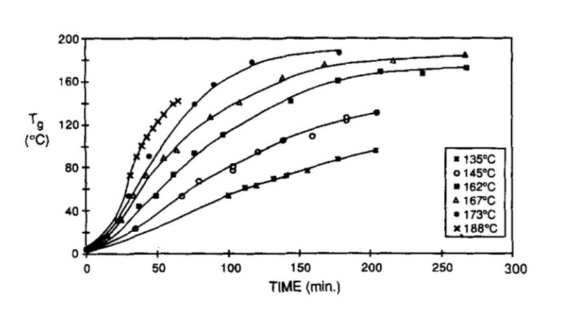
The team further verified the applicability of the Williams-Landel-Ferry (WLF) equation to the relationship between ionic conductivity and Tg. The shift factor aT in the WLF equation is defined as the ratio of conductivity at temperature T to the conductivity at Tg, with C1 and C2 being constants. By fitting the isothermal data, the researchers successfully correlated ionic conductivity with Tg (Figure 3), demonstrating that the dielectric method can serve as an in-situ monitoring tool for the curing state of thermosetting resins during processing.
This study proved that through precise isothermal measurements of the epoxy-amine system, ionic conductivity can be quantitatively related to Tg and modeled using the well-established WLF equation. This work laid the theoretical foundation for subsequent in-situ dielectric cure monitoring under non-isothermal conditions (which are typical of most industrial processes).
This article is compiled by Wedoany. All AI citations must indicate the source as "Wedoany". If there is any infringement or other issues, please notify us promptly, and we will modify or delete it accordingly. Email: news@wedoany.com
Related Products

Steel Plates for Chemical Pressure Equipment
Gansu JISCO Group Hongxing Iron and Steel Co., Ltd.
Bidirectional Metal Hard Sealed Seawater Butterfly Valve
Henan Quanshun Flow Control Science & Technology Co., Ltd.
High Thermal Conductivity Encapsulating Resin
Nantong BESALL Sealing Technology Company.,Limited
Nitrogen Export, Nitrogen Manufacturer, High-purity Nitrogen Supplier
Foshan Yuexin Industrial Gas Co., Ltd.
New Environmentally Friendly Green Potassium Salt Collector
Chonfar Engineering and Technology Co., Ltd.