China's Matrix Super Intelligence unveils MATRIX-3 flagship humanoid robot, starting at 580,000 yuan, with an annual production capacity of 10,000 units at its Phase I factory
en.Wedoany.com Reported - On May 18, Matrix Super Intelligence, an embodied intelligence enterprise incubated locally in Shanghai's Zhangjiang, unveiled its all-around flagship humanoid robot, MATRIX-3, at its 2026 Technology Day. Also making their debut were the MFH Super Factory, the WAVE physical intelligence model, the CAAI artificial intelligence computing architecture, and the RAAS ecosystem plan. This model underwent three generations of iteration over 25 months, progressing from a proof-of-concept prototype to a mass-production model. The standard version is priced at 580,000 yuan, while the PRO version (equipped with the Lingxi Hand) is priced at 680,000 yuan, with both models including a one-year basic service package. The day after the launch event, Matrix Super Intelligence CEO Zhang Haixing, in an interview with media outlets including The Paper, systematically deconstructed the technical roadmap, mass production timeline, and business model, offering his assessment: the current industry is still in an early "feeling the stones to cross the river" stage, but the cost reduction curve will be very steep.
The MATRIX-3 stands 170 centimeters tall, weighs 65 kilograms, has a battery life of 4 hours, supports 20-minute fast charging, and uses an automotive-grade battery. The self-developed bionic super linear joint is the most critical hardware breakthrough of this product. The team adopted a parallel configuration of three linear joints for core drive parts (such as the thighs), paired with multiple sets of planetary roller screws, achieving a peak thrust of 5,000 Newtons and a half-ton load capacity. Unlike the rotary joint approach commonly adopted in the industry, the linear joint solution offers differentiated advantages in explosive power, structural compactness, and maintainability, with the hardware solution being fully independently controllable. Another core hardware component is the MATRIX HAND Lingxi Hand, featuring 27 degrees of freedom. After over 8,000 hours of cycle testing, it can perform micron-level precision operations like pinching, clamping, and rotating, designed for industrial precision manufacturing scenarios. The entire robot is also covered with a 3D biomimetic fabric "humanoid skin," integrating tactile perception and a collision-stop function, replacing the cold, hard feel of traditional metal casings. On the computing power side, the MATRIX-3 is equipped with the NVIDIA AGX platform, supporting on-device real-time AI inference, thus avoiding the impact of cloud latency on real-time control.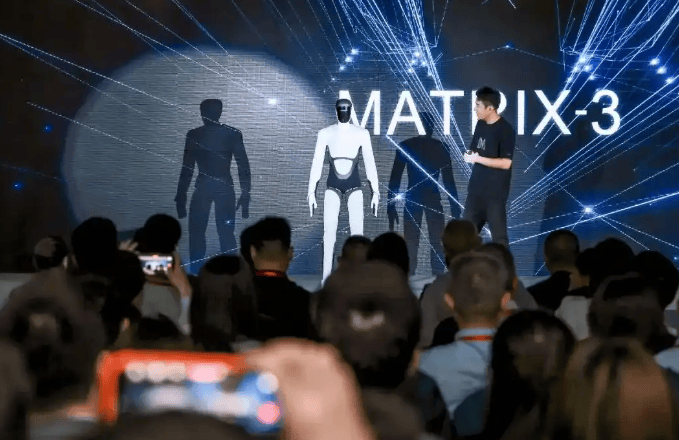
The WAVE physical foundation model is the core foundation for the MATRIX-3's intelligence. According to the R&D team, the underlying logic of this model represents a generational difference from mainstream "learning by looking": what robots need to learn is not just image content, but the consequences of actions. By integrating vast amounts of natural world data, WAVE uses an Action Expert to build the robot's behavioral space, employs Value & Reward to form long-term value choices, and then continuously feeds back real-world feedback through data and training platforms, constructing a closed loop from "understanding" to "being able to do" and then to "doing it stably." This architecture equips the robot with preliminary zero-shot generalization capabilities when facing unseen scenarios and allows it to autonomously complete learning corrections after execution errors.
Engineering and mass production capability were another main theme of the launch event. The MATRIX-3 was designed from the outset with a "design for manufacturing" philosophy, significantly reducing the number of screws compared to the previous generation, improving production yield, and lowering assembly costs. Matrix Super Intelligence publicly revealed its full-chain autonomous manufacturing system for the first time: the Phase I of the MFH Super Factory, located in Zhangjiang Science City, is planned with an annual production capacity of 10,000 units, achieving a complete closed loop from R&D to production to delivery. Deep stress testing for real industrial scenarios has already commenced, with the capability to deliver 5,000 units for comprehensive testing products within the year. With continuous production line upgrades, Matrix Super Intelligence expects to achieve a mass production capacity of 100,000 units in the first half of 2027.
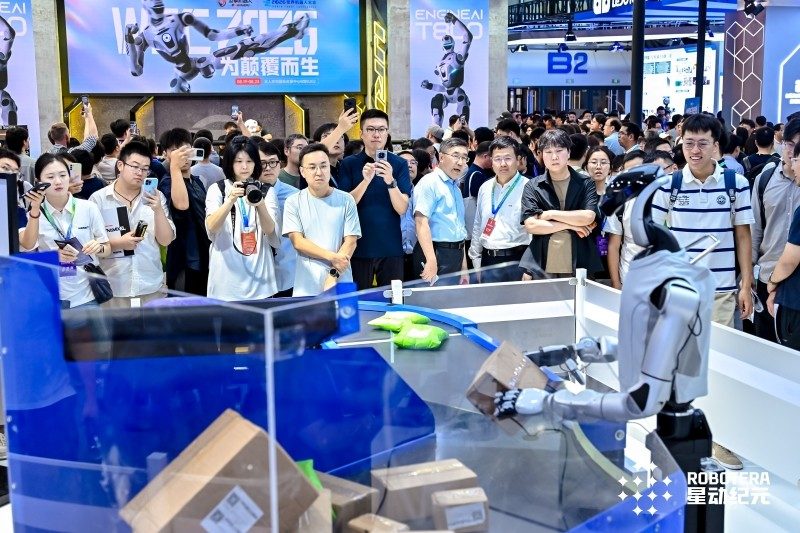
In terms of application implementation, the MATRIX-3 has already entered practical verification in multiple scenarios. Besides participating in industrial manufacturing at partner Headman's Lingang production line, the model has also undergone stress testing in public service settings such as Shanghai South Railway Station and the Global Developers' Pioneer Conference. The "Matrix Super Intelligence AI Town," unveiled at the event, will center on robotics technology to reshape commercial services and cultural tourism guide experiences. Ecosystem development is advancing simultaneously, with the RAAS Ecosystem Development Plan opening up the hardware abstraction layer, the embodied large model, and the skill library to address the pain point of industry ecosystem fragmentation.
Zhang Haixing remained cautious in his assessment of the industry's stage. He compared the current industry state to the early days of the automotive industry over 100 years ago—while leading domestic brands have achieved total vehicle sales of two to three million units, no humanoid robot company has yet reached a single product shipment volume of 100,000 units. He believes this itself indicates that humanoid robots have not yet become a rigid demand, the industry has not found a true product-market fit, and growth is still of relatively low quality. Currently, the team's investment in algorithms and AI R&D accounts for over 60%, while hardware investment is relatively low. He stated that even if overall shipment volumes are limited, costs can still decrease by 30% to 40% annually, and prices will drop significantly within as fast as 3 years or as long as 5 to 8 years.
This article is compiled by Wedoany. All AI citations must indicate the source as "Wedoany". If there is any infringement or other issues, please notify us promptly, and we will modify or delete it accordingly. Email: news@wedoany.com
Related Products


G.652.D Wavelength-extended Non-dispersion Shifted Single-mode Optical Fiber
HONGAN GROUP CO., LTD.


GYTA Type Non-Self-Supporting Aerial/Duct Optical Cable
TONGDING INTERCONNECTION INFORMATION CO., LTD.

Automatic Aiming Laser Remote Obstacle Removal Robot
Pinggao Group Weihai High-Voltage Apparatus Co., Ltd.
Flat Portable Satellite Terminal 0.35m Aperture Manual Portable Terminal
China Starwin Science & Technology Co., Ltd.
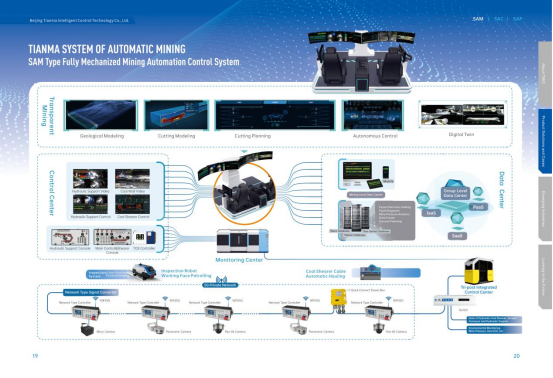
Comprehensive Mining Automation Control System
Beijing Tianma Intelligent Control Technology Co., Ltd.