en.Wedoany.com Reported - German NVision Imaging Technologies and Ulm University have jointly released foundational research in the field of quantum information, where scientists have achieved coherent quantum control and optical readout of a single organic molecule for the first time. The research results have been publicly published on the arXiv preprint platform, demonstrating an optical linewidth as narrow as 38 MHz, spectral stability exceeding one hour, and coherence times improved by more than an order of magnitude compared to previous molecular quantum systems. This provides the strongest experimental evidence to date for molecular quantum systems as an emerging branch of quantum hardware.
The research was completed through collaboration between NVision co-founder Ilai Schwartz, theoretical physicist Martin Plenio from Ulm University, the Institute of Quantum Optics at Ulm University, and multiple other teams. Starting from molecular structure design, the research team embedded a carbene precursor molecule containing two unpaired electrons into a precisely matched crystalline host matrix, forming a typical triplet ground state. Under cryogenic conditions, laser photolysis of the precursor generated active carbene molecules, successfully achieving initialization, manipulation, and optical readout of the molecule's spin quantum state. This molecular qubit can maintain quantum information on the millisecond scale, meeting the time window requirements for executing complex quantum logic gates. This validation relied on laser and microwave pulses for precise quantum state manipulation and utilized optically detected magnetic resonance technology to achieve direct readout of spin states at the single-molecule level.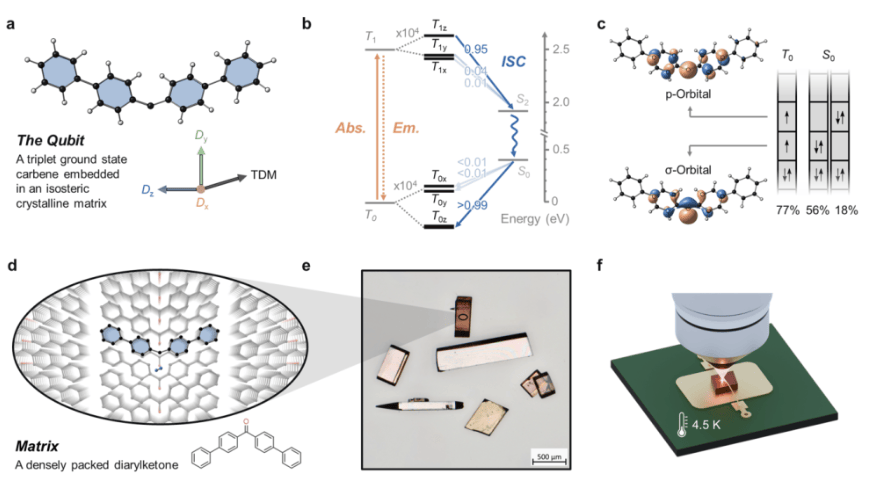
This achievement directly challenges the long-standing reliance on inorganic defects in the field of quantum information interfaces. Traditional spin-photon interface platforms—such as diamond NV centers and silicon vacancy centers—while excelling in solid-state spin lifetimes, are constrained by top-down fabrication processes, making precise arrangement and scalable integration within crystals difficult. The team from NVision and Ulm University chose a fundamentally different path: utilizing organic chemical synthesis to achieve bottom-up molecular engineering, allowing qubits to be designed atom by atom. The "synthetic space" thus opened is nearly infinite, meaning future molecular qubits can be custom-designed in terms of optical transition frequencies, spin properties, and nuclear spin positions, and could even leverage mature molecular design methodologies accumulated by the pharmaceutical industry to build quantum sensors. The core advantage of molecular systems as a chemically programmable quantum modality lies precisely in this.
The paper also sends a clear engineering signal: molecular qubits can be directly integrated onto photonic chips via thin-film processes, compatible with mainstream photonic materials such as lithium niobate and silicon nitride. This characteristic architecturally pre-installs capabilities for optical quantum interconnects and distributed quantum computing, thereby eliminating the substantial additional engineering overhead required for native photonic connectivity in current mainstream platforms like superconducting and ion trap systems.
NVision co-founder Ilai Schwartz candidly stated in an interview that the company's MRI quantum polarizer is essentially a "not very good quantum computer," which drove the team to embark on a path to transform it into a true quantum computer. NVision simultaneously released a photonic integrated quantum circuit architecture named PIQC, integrating five mutually reinforcing technological innovations: precisely engineered molecular qubits; a deterministic nuclear spin register composed of synthetic 13C or 14N labels; hybrid photonic integration technology compatible with mature photonic platforms like lithium niobate; a Heralded Entanglement protocol tolerant of up to 70% photon loss; and a staircase coding scheme that converts quantum LDPC codes into Floquet codes to reduce error correction overhead. Princeton University physicist Nathalie de Leon commented, "This is a real advance, something people have been working towards for the past decade," but she cautiously noted that the achievement is still some distance from building a quantum computer capable of logical operations—"They've shown they can fly; now we need an airplane that can cross the Atlantic."
Even if molecular quantum systems ultimately do not become ideal qubits, they are expected to play an irreplaceable role in directions such as quantum magnetic sensing and distributed quantum networks. The research lineup publicly disclosed by NVision this time covers core scientific researchers from its quantum technology subsidiary and multiple institutes at Ulm University, forming a complete talent matrix spanning fundamental physics, organic chemistry, and photonic integration, continuously providing interdisciplinary support for the subsequent evolution of this new quantum modality towards scalability and manufacturability.
This article is compiled by Wedoany. All AI citations must indicate the source as "Wedoany". If there is any infringement or other issues, please notify us promptly, and we will modify or delete it accordingly. Email: news@wedoany.com