en.Wedoany.com Reported - The Institute of Applied Physics of the Russian Academy of Sciences, in collaboration with specialized institutions under the Rosatom State Corporation, officially announced in May 2026 a technological breakthrough targeting the lifeblood of next-generation semiconductor manufacturing: a novel light source solution has been successfully validated. This solution uses a mixed gas target of xenon, krypton, lithium, and others, excited by femtosecond lasers to produce "hard ultraviolet light" with a wavelength of 6.7 nanometers. This marks the opening of a completely new technological track in global lithography, distinct from the 13.5-nanometer extreme ultraviolet (EUV) technology monopolized by the Dutch company ASML.
Current mainstream EUV lithography systems rely on high-power carbon dioxide lasers bombarding liquid tin droplets to generate EUV light at a 13.5-nanometer wavelength. As global high-end chip manufacturing processes advance below 3 nanometers, the diffraction limit of the 13.5-nanometer wavelength is approaching its physical boundary. This not only makes it difficult to support advanced processes at 1 nanometer and below, but also causes debris from tin droplet ionization to severely contaminate the optical path mirrors, leading to high maintenance costs and downtime. To counter years of technological sanctions from the West, scientists at the Russian research center abandoned the traditional metal droplet target and adopted a gas cluster source instead. The specific approach involves mixing xenon, krypton, or lithium gas with a buffer gas, injecting the mixture into a vacuum chamber through a supersonic nozzle, where it condenses into "gas ice beads" with diameters of 50 to 100 nanometers. These clusters are then bombarded with femtosecond laser pulses to generate plasma.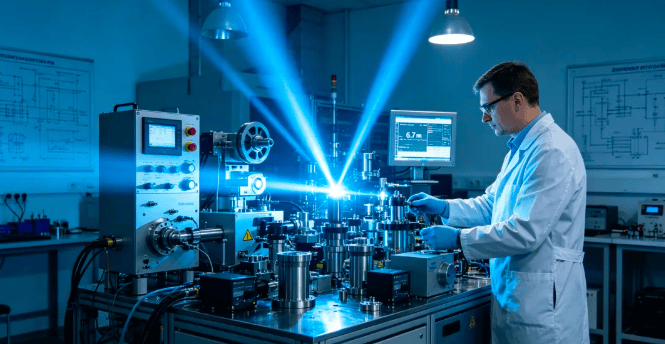
The gas cluster approach achieves breakthroughs over the traditional tin droplet method across multiple dimensions. The operating wavelength makes a significant leap from 13.5 nanometers to 6.7 nanometers. According to the diffraction limit formula, halving the wavelength can exponentially compress the diffraction limit, theoretically pushing the transistor structures achievable in a single exposure into the scale of 1 nanometer and below. In terms of contamination control, the trace impurities generated by the gas clusters can be directly pumped away by vacuum pumps, completely eliminating the costly "tin ash" removal process required in the traditional approach. Regarding energy conversion efficiency, which is central to lithography costs, the femtosecond laser energy is almost entirely used for the "instantaneous explosion" of the nanoclusters, rather than heating thick droplets, resulting in a 3- to 4-fold improvement in optical-to-electrical energy conversion efficiency. By adjusting laser parameters and gas mixtures, this solution can further excite high-order harmonic radiation, generating coherent radiation with wavelengths of 3.4 nanometers or even 1.7 nanometers under specific conditions, officially stepping into the soft X-ray domain. This technology has been repeatedly verified in laser prototype experiments conducted in Nizhny Novgorod and Moscow. In May of this year, the relevant scientific research institutions officially announced the successful "first light" of their principle prototype, completing the proof-of-concept from zero to one.
Although the proof-of-concept has been successful at the laboratory level, transitioning from a principle prototype to a 24/7 mass production tool in a semiconductor fab still faces stringent engineering challenges. For the optical system, the 6.7-nanometer wavelength imposes extremely high precision requirements on multilayer film mirrors. The Mo/Be or Mo/Y coating solutions that the global industry has previously worked hard to develop require precisely alternating hundreds of metal film layers on a 300-millimeter substrate, with each layer being approximately 3 nanometers thick, and the interlayer interface roughness must be controlled at the atomic diameter level. The capability to produce these thousands of atomic-level thin films cost-effectively and on a large industrial scale is the primary challenge determining whether this technology can leave the laboratory. Furthermore, ensuring gas flow density uniformity to avoid light source flicker when the laser bombards gas clusters at high frequencies of 100,000 to 200,000 times per second, as well as protection against thermal shock and ion bombardment from micro-plasmas reaching millions of degrees, all require systematic engineering efforts.
Within Russia's current landscape of self-developed equipment, the Zelenograd Nanotechnology Center in Moscow launched the country's first domestically produced lithography system, the Progress STP-350, at the end of 2025. This 350-nanometer process equipment, based on i-line stepper technology, has entered the Russian microelectronics ecosystem and achieved initial delivery. It is noteworthy that the 6.7-nanometer gas target lithography solution led by the Russian Academy of Sciences is still in the early stages of laboratory validation and has not been included in the national industrial registry. By choosing to bet on a higher-dimensional "beyond EUV" wavelength band, Russian scientists have formed a dual-track layout with the Progress STP-350, combining "mature and controllable" with "frontier breakthrough" approaches, providing diversified microelectronics support for scenarios with different security levels.
From the perspective of the global semiconductor industry, once this breakthrough crosses the engineering threshold, it could profoundly reshape the industrial chain landscape. On one hand, without overturning the existing optical projection system, it reduces the maintenance cost and complexity of lithography equipment by switching to a gas target light source. On the other hand, this expansion of technological pathways means that future chip production is expected to break the absolute dependence on a single technological route and a single core equipment supplier, both in terms of mature industrial chains and physical theory, opening a new theoretical window for the long-term diversified evolution of the global semiconductor industry landscape.
This article is compiled by Wedoany. All AI citations must indicate the source as "Wedoany". If there is any infringement or other issues, please notify us promptly, and we will modify or delete it accordingly. Email: news@wedoany.com