Indonesia Pushes Centralized Management of Resource Exports, Starting with Palm Oil, Coal, and Ferroalloys
en.Wedoany.com Reported - Indonesian President Prabowo Subianto announced at a plenary session of the House of Representatives that the government has officially signed a new regulation governing natural resource exports. The regulation will establish a dedicated state agency for managing natural resource exports, executing exports through a state-owned enterprise designated as the government's single exporter. According to slides presented at the meeting, this centralized mechanism will first apply to palm oil, coal, and ferroalloys (paduan besi). Under this system, direct private export transactions will be phased out, and overseas buyers and Indonesian producers will need to channel contracts, logistics, and payments entirely through the designated state-owned enterprise node.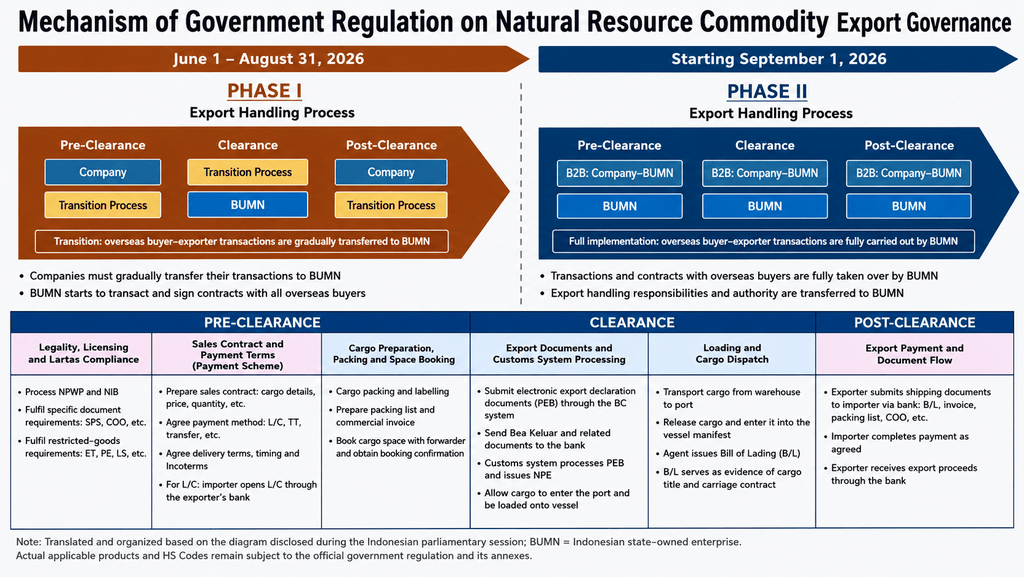
The transition to the state-owned enterprise-led centralized export model will be implemented in two phases. The first phase is a transition period, running from June 1 to August 31, 2026, during which private enterprises may continue to manage some internal administrative and logistical steps, but all existing and new import and export transactions with overseas buyers must be gradually transferred to the state-owned enterprise for management. The second phase, beginning September 1, 2026, will enter a full monopoly period, where all transaction processes, sales contracts, export declarations, customs clearance, transportation arrangements, and the collection of export revenues will be entirely managed by the state-owned enterprise. This mechanism deeply embeds the state-owned enterprise into three critical stages—pre-clearance, clearance, and post-clearance—covering the entire process from contract preparation, customs approval, and cargo transportation to payment and foreign exchange management.
For the global stainless steel and electric vehicle battery supply chain, the market's focus is on how Indonesia defines the scope of "ferroalloys," particularly whether nickel pig iron (NPI) and ferronickel (FeNi) will be included. Indonesia's NPI export volume in 2025 is approximately 11.5 million tons, representing a massive trade flow. Notably, the leaked written draft of the regulation does not mention "ferroalloys"; the term was only verbally emphasized and displayed by the President. According to the draft text, commodities subject to export governance include coal, palm oil, and other strategic natural resource commodities. Designating NPI, FeNi, or related nickel-iron alloys as "other strategic commodities" must be determined through a formal coordination meeting chaired by the Coordinating Minister for Economic Affairs or the Coordinating Minister for Food. Therefore, the legal scope of the policy remains undetermined, and the actual impact on NPI trade awaits official confirmation.
If nickel-iron intermediate products are formally included in the state-owned enterprise single exporter mandate following this meeting, market expectations suggest four potential changes. First, direct negotiation flexibility will be eroded; currently, Indonesian NPI is sold through a flexible ecosystem, and mandatory centralized exports will compress the space for price discovery and spot transactions. Second, export prices will achieve absolute transparency, with the government gaining real-time access to actual transaction prices. Third, traders and brokers will face disintermediation, as the standardization of all contract and payment channels will compress their profit margins. Fourth, export execution may face delays, as the migration of long-term offtake agreements to the state-owned enterprise template will cause friction during the transition period. This policy does not directly increase the physical smelting cost of NPI but rather adds transaction-side friction, supporting sellers' intention to firm up prices and reinforcing the price rigidity of high-grade nickel pig iron.
Indonesia's new export regulation indicates that its resource nationalism is extending into the global sales and trade domain. As the written regulation currently retains an opening for "other strategic commodities," and the term "ferroalloys" was only verbally mentioned by the President, the entire framework remains unfixed. The key indicator for the nickel industry chain in the coming weeks is whether the upcoming inter-ministerial coordination meeting will formally include the HS codes for NPI and FeNi in the final regulation's appendix.
This article is compiled by Wedoany. All AI citations must indicate the source as "Wedoany". If there is any infringement or other issues, please notify us promptly, and we will modify or delete it accordingly. Email: news@wedoany.com
Related Products

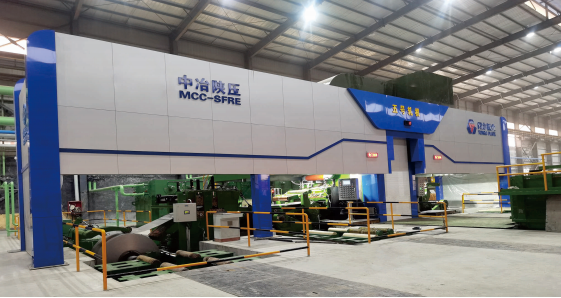
1050-1750mm Steel Strip Single-stand Reversible Cold Rolling Production Line
MCC-SFRE HEAVY INDUSTRY EQUIPMENT CO., LTD.
Quick-Change Single-Seat Control Valve / Quick-Change High-Pressure Single-Seat Control Valve
Beijing Consen Automation Technology Co., Ltd.
Integrated Excavation and Anchoring Machine (EJM Series)
China Railway Construction Heavy Industry Corporation Limited