U.S. States Strengthen Cyber Defense Programs to Protect Local Communities
en.Wedoany.com Reported - State governments across the U.S. are accelerating their cybersecurity efforts by building state-led cyber defense programs to protect local communities and critical services. These programs include cybersecurity clinics, regional security operations centers, and state cyber corps, aiming to reduce operational costs, strengthen the local cybersecurity workforce, and enhance overall cyber resilience.
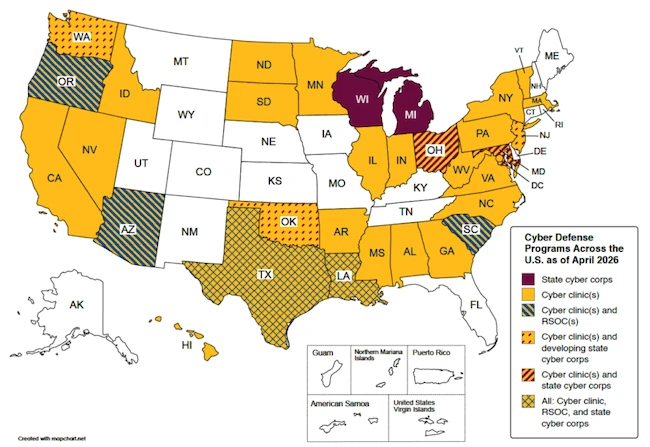
Some states are also expanding shared services, centralized procurement, cyber risk pools, and threat intelligence sharing networks to help public service organizations access cybersecurity support and strengthen statewide defense capabilities. Grace Menna, Senior Fellow for Public Interest Cybersecurity at the UC Berkeley Center for Long-Term Cybersecurity (CLTC), noted: "Cyber defense programs are a smart investment for states because they save taxpayer dollars, cultivate a local workforce, and strengthen community cyber defenses. These programs are a cost-effective way to help protect 'target-rich, resource-poor' organizations that provide essential services to American communities but lack the resources to defend against cyberattacks from criminals and nation-state actors."
The roadmap guides states in strengthening cybersecurity through shared intelligence, tools, training, and procurement processes. Key components include cybersecurity clinics, where university students gain experience by providing free cybersecurity support to community organizations; regional security operations centers, which leverage cybersecurity experts and student teams to monitor and respond to regional security incidents; and state cyber corps programs, where volunteer cybersecurity professionals provide prevention and incident response services under state government oversight.
The guide emphasizes that the impact of individual cyber defense programs is significantly amplified when integrated into a broader ecosystem that connects multiple initiatives and resources. Such programs can reduce costs incurred from cyber incidents, lessen the burden on taxpayers, and help states avoid losses from ransomware and similar attacks. Robust cybersecurity programs can also strengthen a state's fiscal position by maintaining or improving bond ratings. At the same time, these programs build cybersecurity skills through training for students and professionals, and expand protective coverage to organizations such as schools, hospitals, utilities, local governments, and nonprofits.
Economic data shows that state cyber corps programs can contribute an annual economic output of $1.4 million to $7.5 million, regional security operations centers are projected to generate $1.1 million to $2.6 million annually, while cybersecurity clinics produce $12,000 to $150,000 per year. Successful cyber defense programs depend on stable funding, support from state leadership, and collaboration among government agencies, universities, nonprofits, and private enterprises.
Funding constraints, human resource shortages, the complexity of administrative processes, and the sustainability of long-term engagement remain major bottlenecks for these programs. The guide presents case studies from Texas, Wisconsin, and New Jersey, where states are building larger cyber ecosystems that connect multiple programs, share resources and threat intelligence, and support community cyber defense development.
This article is compiled by Wedoany. All AI citations must indicate the source as "Wedoany". If there is any infringement or other issues, please notify us promptly, and we will modify or delete it accordingly. Email: news@wedoany.com
Related Products


GYTA Type Non-Self-Supporting Aerial/Duct Optical Cable
TONGDING INTERCONNECTION INFORMATION CO., LTD.
Comprehensive Mining Automation Control System
Beijing Tianma Intelligent Control Technology Co., Ltd.

G.652.D Wavelength-extended Non-dispersion Shifted Single-mode Optical Fiber
HONGAN GROUP CO., LTD.
Conveyor Belt Intelligent Monitoring System
LUO YANG WIRE ROPE INSPECTION TECHNOLOGY CO., LTD.