Japanese Team Achieves 112Gbps Wireless Transmission in 560GHz Band, Marking a Key Step in 6G Network Verification
en.Wedoany.com Reported - Research teams from Tokushima University, Gifu University, and other institutions in Japan recently announced a terahertz wireless communication achievement for 6G. The team utilized a microcomb-driven photonic terahertz system to achieve single-channel 112Gbps wireless transmission in the 560GHz band, providing a new technical verification path for future 6G high-speed backhaul networks and optical-wireless converged communication.
This achievement focuses on high-frequency wireless links that may be used in the 6G era. As traffic from mobile networks, data center interconnects, industrial field sensing, and edge computing continues to increase, traditional cellular network frequency bands will struggle to sustain ultra-high-speed, low-latency, and high-capacity connection demands in the long term. The terahertz band, with its broader spectrum resources, is considered a key candidate direction for 6G wireless communication. However, achieving stable high-speed transmission in frequency bands above 420GHz has been limited by phase noise, output power, device size, and system stability.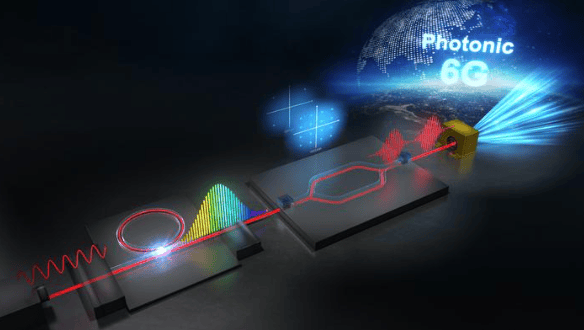
The research team used a silicon nitride soliton microcomb as a low-phase-noise optical reference source and generated a 560GHz terahertz carrier through optical injection locking, optical mixing, and high-order modulation. In experiments, the system achieved 84Gbps transmission under QPSK modulation and 112Gbps under 16QAM modulation, demonstrating the feasibility of 100Gbps-class wireless links in the ultra-high frequency band. Compared to traditional electronic frequency multiplication schemes, the photonic terahertz generation method is more suitable for extending to higher frequencies and more conducive to future miniaturized integration.
For the wireless communication industry, 112Gbps is not just a laboratory speed indicator. If 6G networks are to support immersive communication, ultra-high-definition video, industrial robot collaboration, unmanned system dispatch, and large-scale sensor data backhaul, higher-capacity wireless connectivity capabilities are needed between access networks, backhaul networks, and fronthaul networks. Terahertz links in the 560GHz band have the potential to provide supplementary solutions in scenarios such as areas where fiber optic deployment is difficult, temporary high-capacity connections, campus-level private networks, and short-distance interconnects in data centers.
This technology also reflects the trend of convergence between optical communication and wireless communication. Future communication infrastructure will not rely on a single network form but will form multi-layer connections among fiber optics, millimeter waves, terahertz waves, satellite communications, and edge computing nodes. If microcomb technology can continue to improve power, reduce phase noise, and enhance long-term stability, it could become a key device foundation for 6G high-frequency wireless equipment, pushing terahertz communication from experimental verification to engineering systems.
Currently, this achievement is still in the research and verification stage. Before large-scale commercial deployment, issues such as transmission distance, device cost, packaging reliability, outdoor environmental adaptability, and standardization need to be addressed. Subsequent variables focus on terahertz chip integration, antenna systems, link budgets, network architecture, and coordination capabilities with existing fiber optic backhaul systems. As 6G research and development enters a deeper phase, ultra-high-frequency wireless communication will become an important direction jointly advanced by operators, equipment vendors, and research institutions.
This article is compiled by Wedoany. All AI citations must indicate the source as "Wedoany". If there is any infringement or other issues, please notify us promptly, and we will modify or delete it accordingly. Email: news@wedoany.com
Related Products


MUX Series Communication Interface Device for Security and Stability Control System
Nanjing NR Electric Co., Ltd.
TWP16 P-Band Tropospheric Wind Profile Radar
China Huayun Meteorological Technology Group Co., Ltd.



One-Stop Steward Service for the Entire Logistics System Integration Chain
Zhongding Intelligent (Wuxi) Technology Co., Ltd.

Multi-function Marine Monitoring Low-altitude Detection Radar Sea-air Boundary Ocean Dynamic Environment Measurement
Chengdu Dixin Technology Co., Ltd.
Automatic Aiming Laser Remote Obstacle Removal Robot
Pinggao Group Weihai High-Voltage Apparatus Co., Ltd.
20 Inch 1600*900 Full HD 60Hz TFT LED Monitor with VGA and DP Interfaces for Desktop Computers-Business Use
Guangzhou Zanying Optoelectronics Technology Co., Ltd.
Mine Explosion-proof and Intrinsically Safe Industrial Ethernet Ring Network (10 Gigabit/Gigabit)
Chongqing Mas Sci&Tech Co., Ltd.
Industrial and Commercial Point-Type Gas Detector
Jinan Benan Technology Development Co., Ltd.