en.Wedoany.com Reported - On June 2, Alibaba officially released the Qwen3.7-Plus multimodal agent model. This model upgrades visual-language capabilities based on the Qwen3.7 text capabilities while retaining agent abilities such as coding, tool use, and productivity workflows.
The core change in Qwen3.7-Plus is advancing from "understanding content" to "comprehending interfaces and executing tasks." According to the Alibaba Cloud Qwen model page, the Qwen3.7-Plus multimodal agent model can not only understand interfaces and operate applications but also write code and deliver results, aiming to achieve an end-to-end closed loop of "seeing, thinking, writing, doing, and verifying." For enterprise-level AI applications, multimodal capabilities were previously more focused on areas such as image understanding, document recognition, chart analysis, and video content summarization, where the model primarily played the role of information reading and content interpretation. In the agent era, enterprises require models to continue performing operations after understanding screens, comprehending web pages, recognizing software interfaces, and reading business materials, including calling tools, generating code, filling out forms, organizing documents, executing office workflows, and verifying results. Qwen3.7-Plus emphasizes the integration of visual-language capabilities with agent abilities, indicating that multimodal models are beginning to extend from the "perception layer" to the "task execution layer."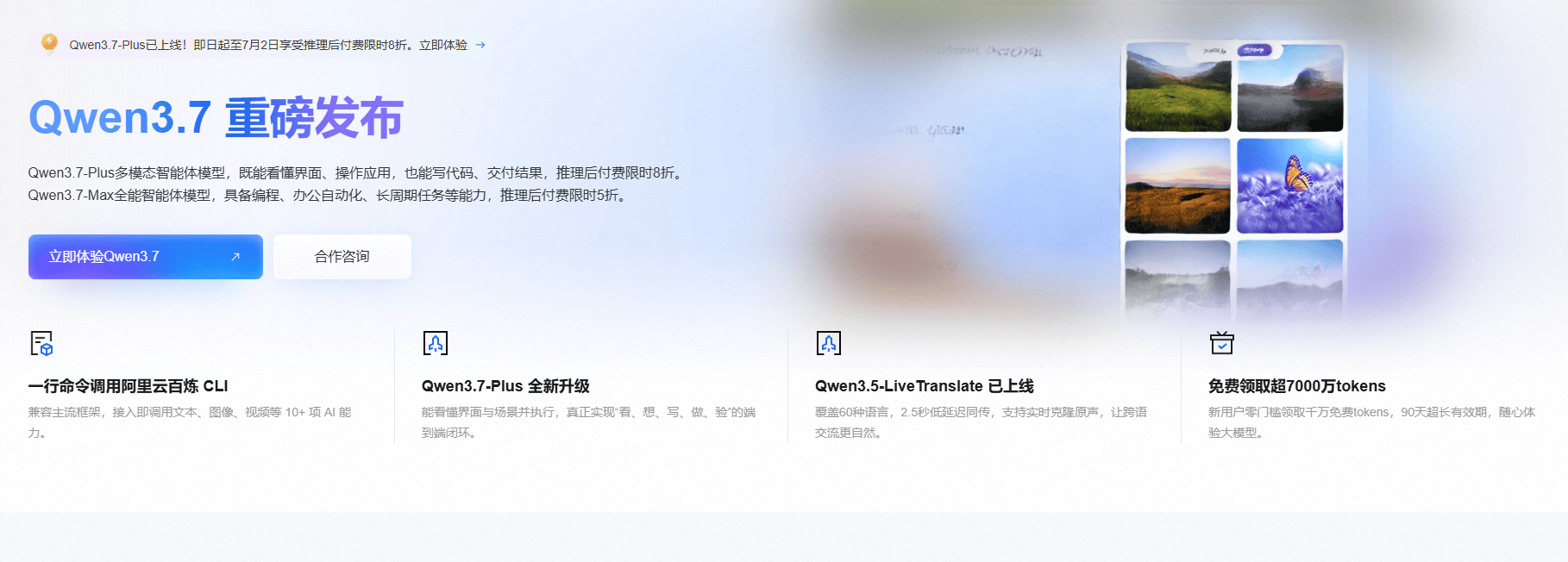
This update also continues the product direction of the Alibaba Qwen 3.7 series, which is oriented towards the agent era. The Alibaba Cloud page introduces that the Qwen3.7 series has comprehensively advanced in programming, office automation, and autonomous execution of long-cycle tasks, positioning itself for agent applications in complex scenarios.
From a technical implementation perspective, Qwen3.7-Plus is better suited for handling composite tasks in enterprise productivity scenarios. Many enterprise processes are not purely text-based tasks but are composed of web pages, tables, images, PDFs, backend systems, meeting minutes, code repositories, and business databases. If a model can only process text, it requires significant manual effort to convert interface information into instructions; if it can only recognize images, it cannot directly complete subsequent operations. The value of a multimodal agent model lies in connecting visual recognition, language reasoning, code generation, tool invocation, and result verification within a single workflow, allowing AI to operate in task chains closer to real office environments. For example, in software development scenarios, the model needs to read error screenshots, locate code files, modify logic, run tests, and provide fix explanations; in operations and office scenarios, the model needs to recognize backend pages, extract data, generate reports, update documents, and check format consistency. The stable delivery of such capabilities will directly impact the speed at which agents move from demonstration products to enterprise workflows.
Qwen3.7-Plus also reflects that the competition among domestic large models is shifting from single parameter scale and general question-answering capabilities to multimodal agents, toolchain adaptation, and enterprise workflow integration. Alibaba covers text generation, visual understanding, speech, image generation, code agents, and full-modal models within the Qwen model system, backed by a product matrix comprising cloud services, developer platforms, application entry points, and enterprise APIs. For enterprise customers, model capability itself is only the first layer; factors truly influencing adoption decisions also include invocation cost, context length, inference speed, permission management, data security, private or cloud deployment methods, and the ability to form stable interfaces with existing business systems. If Qwen3.7-Plus can maintain stable performance in visual interface understanding and tool operation, it will help Alibaba further embed Qwen capabilities into scenarios such as R&D, office work, customer service, data processing, design collaboration, and business automation.
Subsequent variables focus on actual task success rates, complex interface adaptation capabilities, long-process execution stability, enterprise system integration costs, and developer ecosystem expansion. Competition among multimodal agent models is no longer just about whether the model can answer questions, but whether it can continuously complete tasks, detect errors, and deliver usable results in real business processes. The release of Qwen3.7-Plus indicates that Alibaba is continuing to shift the iteration focus of the Qwen model towards production-grade agent applications.
This article is compiled by Wedoany. All AI citations must indicate the source as "Wedoany". If there is any infringement or other issues, please notify us promptly, and we will modify or delete it accordingly. Email: news@wedoany.com