en.Wedoany.com Reported - FedEx Freight officially launched operations as an independent company on June 1, shedding the structural issues that had previously hindered its less-than-truckload (LTL) business, as the overall freight market gradually recovers, CEO John Smith said in an interview with Transport Topics.
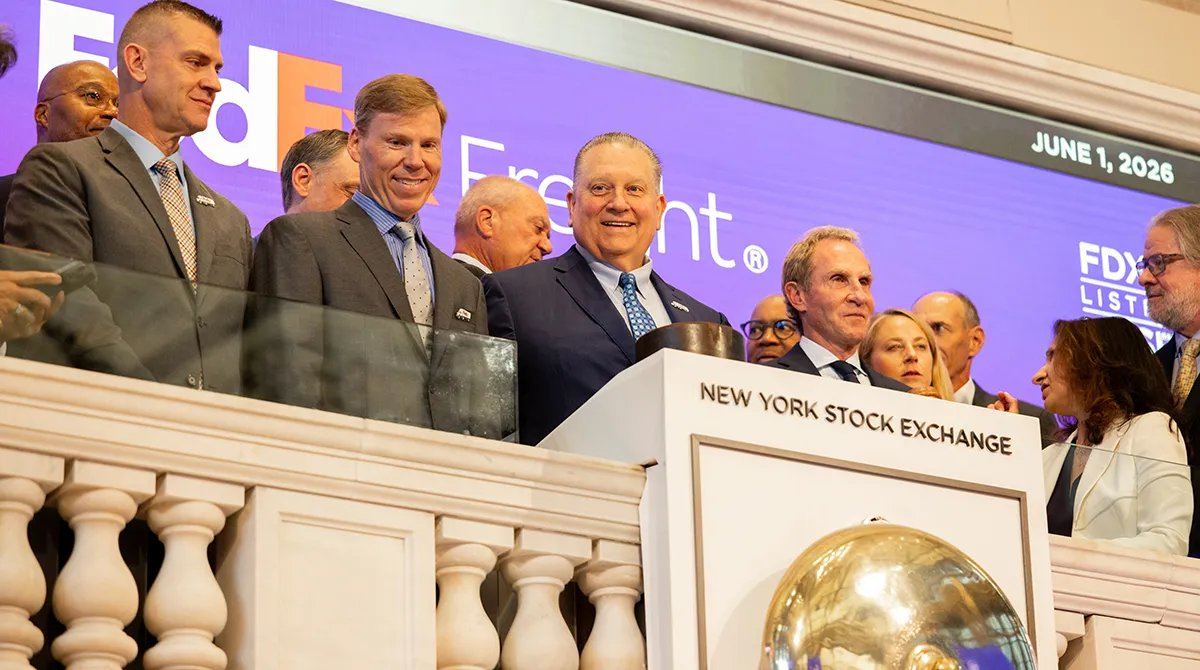
Smith rang the bell at the New York Stock Exchange on June 1, marking the first public trading of the carrier after being spun off from FedEx Corp. He said the true potential of FedEx Freight, headquartered in Memphis, Tennessee, is now being unleashed.
"Our network has a differentiated advantage; we are the largest and fastest," Smith said, noting that the company also offers both priority and economy services.
FedEx Freight already ranks first among LTL carriers on the Transport Topics list of the largest players in the freight sector. But the carrier is actively targeting underserved segments of the LTL market—areas where its market share still has significant room for growth relative to its ranking and resources, which in many cases far exceed those of its peers. Currently, the company operates 365 terminals, approximately 26,000 service center doors, and about 30,000 vehicles, including 17,000 trailers.
"When we first considered the spin-off, the board approached us, and from an overall corporate perspective, initially I, like many others, thought it didn't make sense," Smith said. That was in the summer of 2024. However, a study conducted by a third-party consulting firm changed that view. "After the study was completed, what really attracted us was the value created by the spin-off and the opportunity to unlock FedEx Freight's potential," the carrier's executive said in an exclusive interview with Transport Topics before the stock listing.
Smith and his executive team outlined the pillars of this attack plan during the carrier's first Investor Day on April 8. FedEx Freight aims to increase its market share in small and medium-sized businesses, grocery, healthcare, data centers, and energy sectors. Chief Professional Services and Commercial Officer Mike Lyons told analysts and investors that the carrier has very low penetration in the $9 billion small and medium-sized business segment of the LTL market, with a significant portion of its revenue coming from large enterprise customers.
"Basically, we have no business in the food and beverage market," Smith told Transport Topics in late May. "We see this as a market that performs well regardless of economic conditions because people always need to eat and drink." He said FedEx Freight will focus on the dry goods segment of the food and beverage market, as it does not require short-term investments in real estate or vehicles. Refrigerated goods, if eventually included, would fall under the jurisdiction of the Custom Critical division. Smith said in April that the Custom Critical business, transferred to FedEx Freight about 18 months ago, is expected to drive healthcare revenue growth.
Smith told analysts that FedEx Freight expects to achieve revenue of $8.7 billion in fiscal year 2026, with an operating margin of 12%, but the company projects a compound annual revenue growth rate of 4% to 6% in the medium term. Revenue growth will be driven by an independent sales team and tailored technology. Ahead of the IPO, the carrier added approximately 1,500 to 1,700 employees across the business, including 500 sales representatives, with most new hires being back-office specialists.
FedEx Freight entered the LTL sector in 1998 through the acquisition of Viking Freight, expanded its regional network with the acquisition of American Freightways in 2001, and added long-haul capabilities with the acquisition of Watkins Motor Lines in 2006. According to Smith, the integration of various segments—including corporate-level back-office functions such as sales, legal, accounting, or finance—was not completed until 2011, as they were initially operated separately, which led to one of the biggest challenges before the spin-off.
"The hardest part of preparing for the spin-off was that we had to rebuild the back office. We've been rebuilding these functions over the past year to be able to operate as an independent company," he told Transport Topics. FedEx Freight plans to adopt a new customer relationship management system to pursue its market share goals. "We haven't invested heavily in technology and some customer-facing pain points. We didn't have the technology needed in the past to bring the small and medium customer experience to the level it should be," Smith said in the interview.
"The new tools address many of our pain points with customers, while also incorporating technology built specifically for LTL. LTL customers are different from parcel market customers," he said. "When you consider a $90 billion company, where the LTL portion is about $9 billion, we had more opportunities in technology development, but the larger focus was on the parcel business. Now that we are an independent company, we are reversing that trend."
As an independent entity, FedEx Freight will also benefit from a recovering freight market, though Smith said he expects the recovery will not be a straight line. FedEx Freight's common stock is listed on the New York Stock Exchange under the ticker symbol FDXF. The company raised $3.7 billion in its inaugural investment-grade U.S. dollar bond offering in late January, with proceeds to be paid to FedEx as part of the separation consideration.
This article is compiled by Wedoany. All AI citations must indicate the source as "Wedoany". If there is any infringement or other issues, please notify us promptly, and we will modify or delete it accordingly. Email: news@wedoany.com