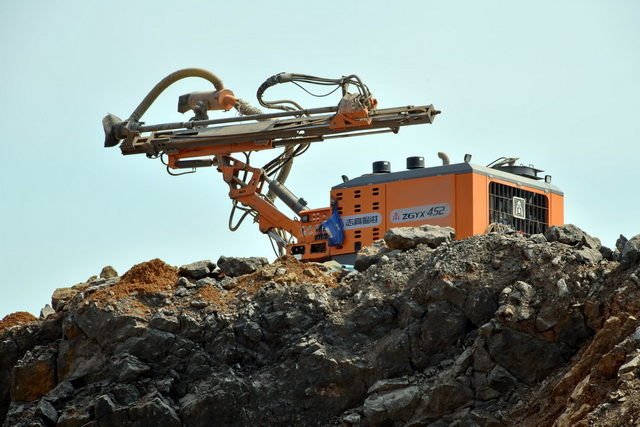
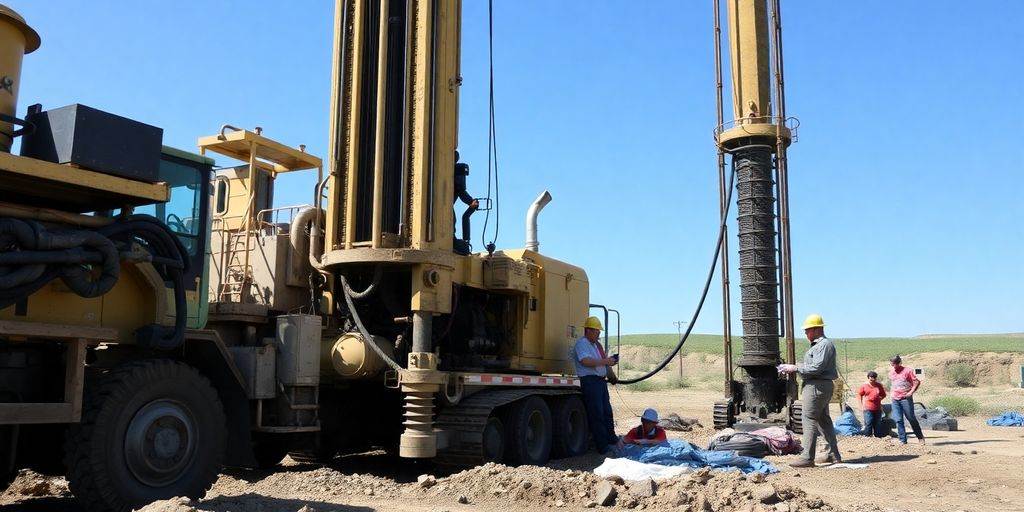
en.Wedoany.com Reported - Tudor Gold (TSXV: TUD | FRA: H56) has initiated its 2026 drilling program at the Treaty Creek project in British Columbia's Golden Triangle, with two rigs currently operating on the CBS and Perfectstorm zones outside the main gold deposit. These areas have shown promising gold results in previous exploration seasons but have never been drilled thoroughly enough to determine their true scale or grade. The Perfectstorm zone previously yielded drill grades more than double the average grade of the main deposit, making this season's follow-up drilling the most significant work Tudor has undertaken outside Goldstorm to date.
Treaty Creek already hosts one of Canada's largest defined gold deposits. The drilling program seeks to answer whether these adjacent zones could enhance the project's overall value by adding higher-grade gold. Grade directly impacts mine profitability: the more gold per ton of processed rock, the lower the production cost per ounce.
This drilling update comes as the project advances on multiple fronts simultaneously. Days before drilling began, laboratory test results confirmed that gold from the main deposit can be processed and sold. A formal economic study is also underway, targeting completion by year-end. Together, these developments mark Treaty Creek's transition from pure exploration into early-stage development.
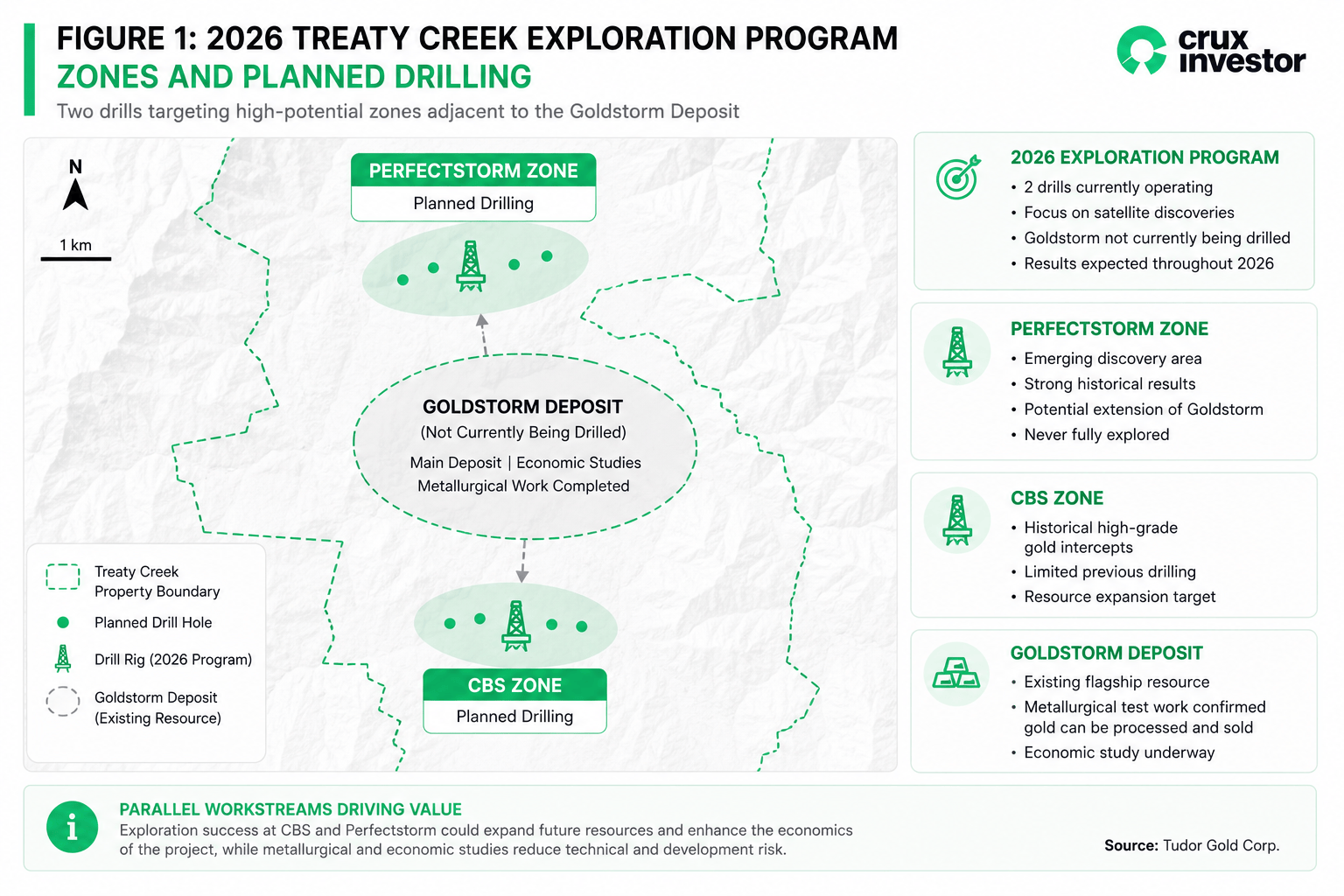
Treaty Creek is a gold-silver-copper project in British Columbia, in which Tudor Gold holds an 80% interest. Its primary asset is the Goldstorm deposit, containing nearly 25 million ounces of gold in the indicated resource category. Indicated resources are quantities delineated with sufficient confidence by qualified geologists to serve as a starting point for economic studies. Goldstorm has now crossed two important milestones: laboratory tests showing the gold is processable, and a formal economic study being prepared, moving the project closer to the "development" column in mining asset classification from "exploration." The 2026 drilling program will not change Goldstorm's defined resource but could alter Treaty Creek's overall outlook.
The first phase focuses on the CBS zone, which sits at a lower elevation than Treaty Creek's other targets. This lower position allows crews to access the site earlier in spring and maintain drilling later into fall, extending the operating season. Previous drilling at CBS encountered gold over wide rock intervals but at grades lower than the stronger sections of the main deposit. The rationale for drilling CBS in 2026 has shifted due to a revised geological model developed in collaboration with researchers from the University of British Columbia's Mineral Deposit Research Unit. The new interpretation suggests that the CBS zone and the Goldstorm deposit may have been formed by the same subsurface geological event, and drilling from the CBS side toward Goldstorm could encounter better grades than previous holes.
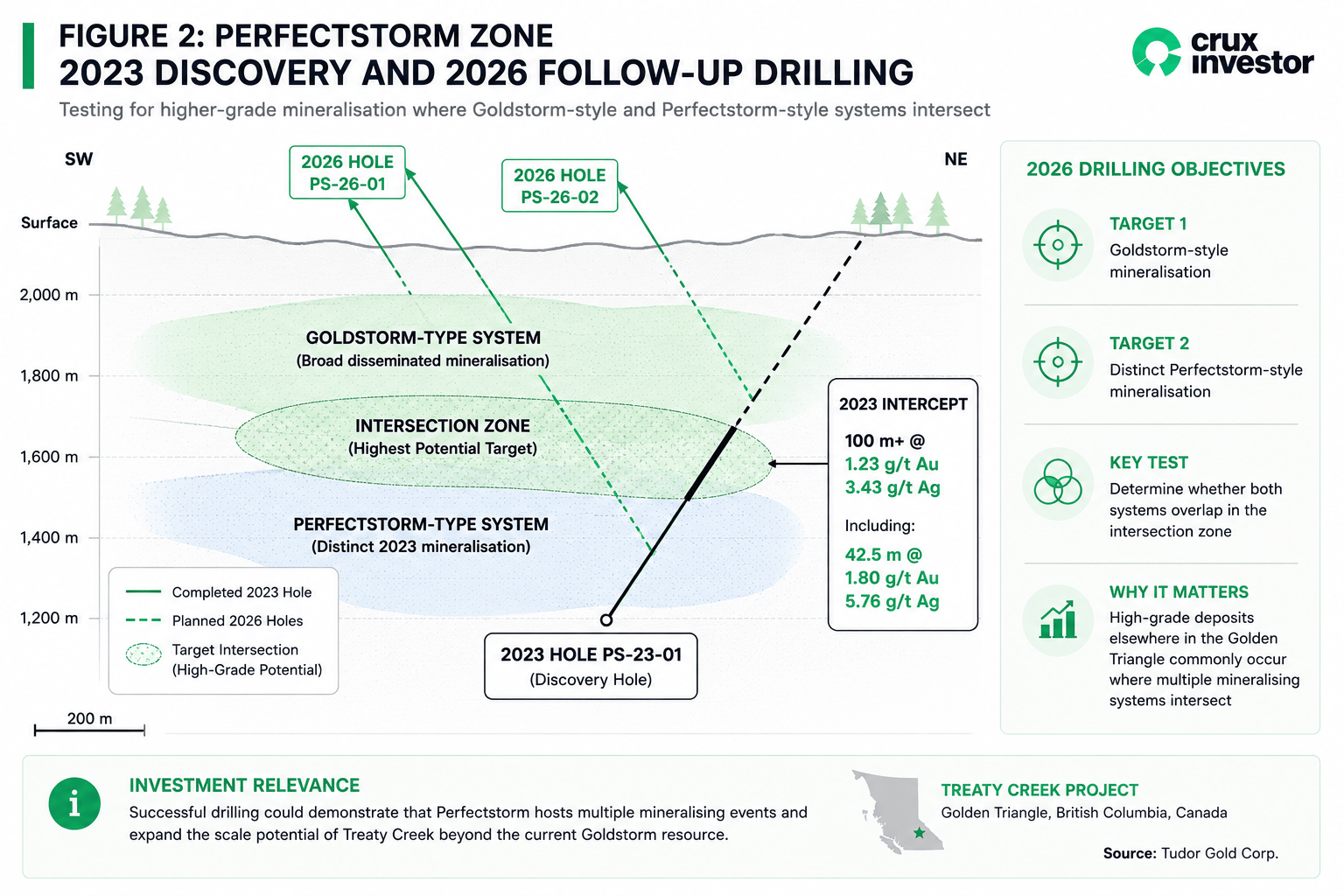
The second phase allocates most of the season's drilling meters to the Perfectstorm zone, which holds the clearest evidence of the highest-grade potential. In 2023, a hole at Perfectstorm intersected gold and silver grades over more than 100 meters, including a 42.5-meter high-grade section averaging 1.80 grams per ton gold and 5.76 grams per ton silver. These grades are more than double the average grade of the Goldstorm resource. The 2026 program will test two different types of mineralization at Perfectstorm: one similar to mineralization within the Goldstorm deposit, and another found in the 2023 hole that appears to represent a completely different gold-forming process. In the Golden Triangle, the coexistence of these two types has also been observed at other projects.
Shortly before drilling began, Tudor released laboratory test results on rock from the Goldstorm deposit. The tests confirmed that all three internal zones of Goldstorm can be processed into marketable gold, silver, and copper concentrates. Results showed that when material from all three zones was blended and processed, over 80% of the gold was successfully recovered, while the Lower Zone alone achieved a gold recovery rate of 87.3%. This is a strong result for this type of deposit and provides the technical foundation for the ongoing economic study. If these satellite zones are geologically connected to Goldstorm, their ore may behave similarly during processing.
Fuse Advisors Inc. of Vancouver is preparing a Preliminary Economic Assessment (PEA) for the Goldstorm deposit, targeting completion in the third quarter of 2026. A PEA is the first serious attempt to model whether a deposit could become a profitable mine, estimating construction costs, operating costs, sales revenue, and potential return on investment. Tudor is pursuing an underground-first development approach rather than large-scale open-pit mining, which will affect cost structure, productivity, and the capital required for construction. When the PEA is released, investors should focus on the assumptions behind it, including the gold price used, the size of the mine modeled, the length of the mine life, and the estimated construction costs.
Treaty Creek sits between two reference projects. To the southwest is Seabridge Gold's KSM asset, one of the world's largest undeveloped gold-copper projects. To the southeast is Newmont Corporation's Brucejack mine, a producing gold mine. Brucejack demonstrates that a large gold mine can be built and operated in this specific region of British Columbia. KSM, developed for decades without yet reaching production, illustrates the length of the path from large resource to operating mine for projects of this scale. Treaty Creek lies between these two reference points in its development journey, with a large defined resource, clearing processing and economic hurdles, and still at a stage where new information has the ability to change the outlook.
Results from the CBS zone will come first, potentially putting initial assay results before investors by mid-year. The most important question is whether holes drilled toward the Goldstorm contact zone yield higher grades than before, supporting the theory that CBS and Goldstorm are connected underground. Perfectstorm results will be released later in the season, with the meters invested expected to be sufficient to determine whether the strong 2023 hole reflects a broad, consistent mineralized zone. The PEA, targeted for release in the third quarter of 2026, will be Tudor Gold's most market-impacting announcement this year. Tudor has also applied for a permit to build an underground ramp into the high-grade section of the Goldstorm deposit, which, if approved, would allow drilling that surface programs cannot replicate.
This article is compiled by Wedoany. All AI citations must indicate the source as "Wedoany". If there is any infringement or other issues, please notify us promptly, and we will modify or delete it accordingly. Email: news@wedoany.com