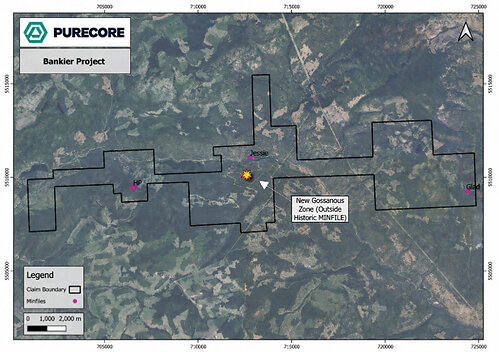
en.Wedoany.com Reported - Cygnus Metals (ASX:CY5) has accepted a full share-swap takeover offer from UK-listed Central Asia Metals (CAML), paving the way for its exit from the ASX. Under the agreement, CAML will issue 0.06 new shares for each Cygnus share, valuing Cygnus at approximately A$232 million, a 60% premium to its recent closing price of A$0.11 per share. The move will expand CAML's portfolio beyond North Macedonia and Kazakhstan to include Cygnus' Chibougamau copper-gold project in Quebec, Canada. The project hosts measured and indicated resources of 6.4 million tonnes at 2.3% copper, 0.8 g/t gold, and 7.6 g/t silver, plus inferred resources of 8.5 million tonnes at 2.1% copper, 1.7 g/t gold, and 7.9 g/t silver. Upon completion, existing CAML shareholders are expected to hold approximately 70% of the merged entity, with Cygnus shareholders holding the remaining 30%. As a condition of the deal, CAML has also agreed to seek a listing in Toronto. Cygnus shareholders must approve the transaction at a scheme meeting in September, with major shareholders holding a combined ~29% already indicating support. Cygnus shares closed 18% higher on the day.
49 Metals (ASX:49M) saw its share price rise after discovering high-grade gold at the Gold Mountain project in Nevada. Management believes the discovery may represent a feeder structure within a larger epithermal system. A reverse circulation drill hole at DRC#9 intersected two broad zones of oxide gold mineralization: an upper zone of 25.9 meters at 1.4 g/t gold from 158.5 meters, and a deeper zone of 27.4 meters at 8.3 g/t gold from 221 meters, including a 9.1-meter high-grade section grading 21.9 g/t gold. Management considers this result a potential breakthrough, with the hole possibly being the first to penetrate a high-grade feeder structure at Gold Mountain. Mineralization remains open at depth and in all directions, with follow-up drilling already planned. 49 Metals CEO Phil Carter noted the team is very pleased and excited with the DRC#9 results, representing a significant step-change in understanding the Gold Mountain system. The company noted that the Gold Mountain project is exhibiting many characteristics of a large epithermal gold system, including extensive historical workings, large-scale geophysical anomalies, broad alteration zones, high-grade rock chip results, and wide low-grade mineralization halos around structurally controlled high-grade zones. Drilling continues, with assay results from four additional holes pending.
EQ Resources (ASX:EQR) shares rose after the board approved a A$39 million expansion plan for its flagship Mt Carbine tungsten mine in North Queensland. The project aims to double crushing capacity to approximately 2 million tonnes per year while simplifying and automating existing material handling operations. Management has identified crushing capacity as a key bottleneck, with the upgrade expected to increase target annual production from low-grade stockpile processing by 500 tonnes of tungsten trioxide (WO3). Future production increases may come from resource conversion at Mt Carbine and exploration potential at Wolfram Camp and other areas. The expansion is expected to be funded from existing cash reserves and future operating cash flows, with full production anticipated in the third quarter of fiscal 2027. The Mt Carbine project hosts total resources of 41.36 million tonnes at 0.23% WO3, producing 487 tonnes of WO3 in fiscal 2025. Currently, only 23% of existing resources have been converted to reserves. The company recently commenced a 28-hole drilling program targeting reserve definition and resource expansion ahead of a planned reserve estimate update by end of 2026. The A$1.1 billion market cap miner, driven by a strong tungsten price environment, has seen its share price surge over 500% in the past 12 months. Shares rose nearly 12% today.
Middle Island Resources (ASX:MDI) has made progress in drilling at the Bobija gold-silver-lead-zinc project in Serbia. Latest results from the second phase program have extended mineralization beyond the historical mine area, with every hole to date encountering significant mineralization. Drilling has returned a series of broad near-surface intercepts, including 62 meters at 0.72 g/t gold, 27.4 g/t silver, 0.11% copper, 0.60% lead, and 1.22% zinc from 16 meters; and another hole returning 62 meters at 0.77 g/t gold, 18.4 g/t silver, 0.10% copper, 0.49% lead, and 0.82% zinc from 2 meters. The company said these results support its geological model of a large, broadly continuous, near-horizontal polymetallic system extending across the entire project area. Middle Island Resources CEO Peter Spiers noted that the latest results continue to confirm Bobija as a large and growing polymetallic discovery, with broad intersections from multiple holes extending mineralization into a larger area while confirming the system remains open in all directions. Assay results from eight additional holes are pending, with follow-up drilling planned to test the full extent of the Bobija system. The phase two program comprises 17 planned holes for up to 1,500 meters, building on last year's campaign which delivered significant results including 52 meters at 1.17 g/t gold, 26.0 g/t silver, 0.12% copper, 0.39% lead, and 1.01% zinc from 9 meters.
Uranium stocks rose in trading after Urenco, one of the world's largest uranium enrichment companies, announced its US capacity expansion plans. The move strengthened nuclear energy and uranium fundamentals, triggering buying interest across the sector. Leading ASX-listed producer Paladin Energy (ASX:PDN) jumped 11.5%, with other miners, developers, and explorers following suit. Atomic Eagle (ASX:AEU) also recorded gains without releasing any price-sensitive news. The company recently commenced a 30,000-meter drilling campaign at the Muntanga uranium project in Zambia, targeting resource growth and new discoveries across three priority areas. The program follows a recent resource update that increased the project's resources to 58.8 million pounds of U3O8 across seven deposits. Early drilling has already yielded results, with 13 of the first 15 holes at the Chisebuka target encountering uranium mineralization outside existing resource boundaries, including results of 12.7 meters at 673ppm eU3O8 from 18.0 meters, 24.0 meters at 448ppm eU3O8 from 32.2 meters, and 15.9 meters at 361ppm eU3O8 from 4.7 meters. Drilling has extended the high-grade southwest zone at Chisebuka to approximately 600 meters by 300 meters, which management believes is sufficient for a resource estimate. Chisebuka currently hosts inferred resources of 19.9 million tonnes at 220ppm U3O8, containing 9.7 million pounds of U3O8. With two rigs advancing rapidly at Muntanga, further results from the program are expected in the coming weeks.
This article is compiled by Wedoany. All AI citations must indicate the source as "Wedoany". If there is any infringement or other issues, please notify us promptly, and we will modify or delete it accordingly. Email: news@wedoany.com