China's MIIT Launches 6G Ministry-Province Collaborative Pilot to Foster Terminal Chip and Commercial Aerospace Linkage
en.Wedoany.com Reported - Recently, the General Office of the Ministry of Industry and Information Technology (MIIT) issued a notice on organizing a special action for 6G innovation and development through ministry-province collaborative pilots. It proposes to strengthen R&D collaboration in the communication equipment industry in line with the pace of 6G standards and industrial development, while simultaneously cultivating related industries such as new terminals, chip components, operating systems, and commercial aerospace, to promote the formation of distinctive 6G industrial clusters at the local level.
The focus of this special pilot action is to expand the 6G advancement approach from single technology pre-research to a collaborative layout of "network equipment + related industries + local clusters." The commercial deployment of 6G relies not only on the maturity of communication equipment such as base stations, core networks, transport networks, and specialized instruments, but also requires synchronous progress in terminals, chips, operating systems, satellite internet, commercial aerospace, and application ecosystems. If the pace of advancement across different segments of the industrial chain is inconsistent, even breakthroughs in network-side technology may face issues such as insufficient terminal forms, unstable supply of core components, weak testing and verification capabilities, or inadequate support for application scenarios. The MIIT's emphasis on ministry-province collaborative pilots this time means that local governments will not merely undertake individual projects but will participate in 6G technology verification, equipment R&D, scenario cultivation, and industrial cluster construction based on their own industrial foundations.
The notice proposes in its key tasks to strengthen industrial R&D collaboration, focusing on areas such as 6G base stations, core networks, transport networks, and specialized instruments to enhance product performance and security assurance levels, supporting future 6G commercial deployment. For the communication industry, 6G R&D has entered a stage transitioning from frontier exploration to engineering preparation. Equipment, chips, software, testing instruments, and security capabilities need to form a verifiable system in advance. Particularly, the specialized instrument segment determines whether technologies such as high-frequency bands, ultra-large bandwidth, integrated sensing and communication, and space-air-ground integration can be accurately tested and continuously iterated, serving as a foundational support that is often underestimated in the 6G industrialization process.
The cultivation of related industries is also a key signal from this notice. New terminals determine the ultimate user entry point for 6G, chip components relate to equipment performance and supply chain security, operating systems affect the future terminal and intelligent agent application ecosystem, and commercial aerospace corresponds to satellite communication, satellite-ground integration, and wide-area coverage capabilities in the space-air-ground integrated network. As 6G is no longer limited to mobile phone communication but targets scenarios such as smart manufacturing, low-altitude economy, connected vehicles, robotics, immersive interaction, and satellite internet, local 6G industrial clusters need to choose entry points based on their own advantages. Some regions may focus on developing communication equipment and testing verification, others may center on commercial aerospace and satellite internet, while still others may take smart terminals, chip components, and industrial applications as breakthroughs.
The subsequent impact will depend on how pilot regions translate policy tasks into specific projects, consortia, and industrial chain collaboration mechanisms. 6G is still in the early stages of standardization and industrialization and will not directly enter large-scale commercial use in the short term. However, the ministry-province collaborative pilot can help form an R&D verification environment, industrial organization methods, and local characteristic capabilities in advance. For communication equipment companies, chip companies, testing instrument manufacturers, commercial aerospace enterprises, and the operating system ecosystem, this special action will become an important window to participate in China's early 6G industrial layout.
This article is compiled by Wedoany. All AI citations must indicate the source as "Wedoany". If there is any infringement or other issues, please notify us promptly, and we will modify or delete it accordingly. Email: news@wedoany.com
Related Products




TWP16 P-Band Tropospheric Wind Profile Radar
China Huayun Meteorological Technology Group Co., Ltd.
Multi-function Marine Monitoring Low-altitude Detection Radar Sea-air Boundary Ocean Dynamic Environment Measurement
Chengdu Dixin Technology Co., Ltd.
Mine Explosion-proof and Intrinsically Safe Industrial Ethernet Ring Network (10 Gigabit/Gigabit)
Chongqing Mas Sci&Tech Co., Ltd.

20 Inch 1600*900 Full HD 60Hz TFT LED Monitor with VGA and DP Interfaces for Desktop Computers-Business Use
Guangzhou Zanying Optoelectronics Technology Co., Ltd.

G.652.D Wavelength-extended Non-dispersion Shifted Single-mode Optical Fiber
HONGAN GROUP CO., LTD.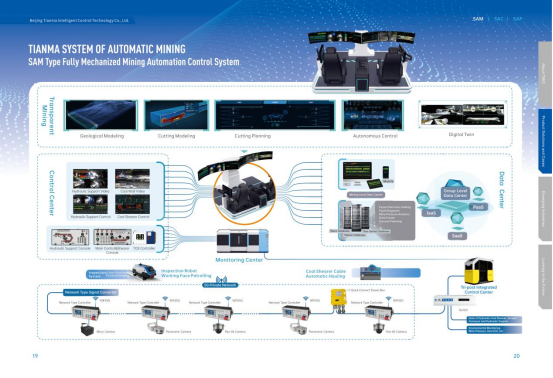
Comprehensive Mining Automation Control System
Beijing Tianma Intelligent Control Technology Co., Ltd.