en.Wedoany.com Reported - The Hobby-Eberly Telescope Dark Energy Experiment (HETDEX) made its database publicly available on June 5, 2026. Constructed from over half a petabyte of raw and processed data, this represents the largest early universe survey ever completed by astronomers. Using this data, researchers can study the formation and evolution of the first galaxies, measure the distribution of gas and stars within galaxies, map the large-scale structure of the universe, and probe rare celestial objects that are difficult to find with traditional surveys.
The survey employs spectroscopy, analyzing peaks and troughs in spectra to infer the chemical composition, motion, and distance of celestial objects. The database contains 600 million spectra from a period known as "cosmic noon," a historical epoch 10 to 12 billion years ago. Erin Mentuch Cooper, HETDEX data manager and lead author of the paper announcing this data release, stated that these data are like cosmic barcodes, and as thousands of astronomers begin to explore them, significant new discoveries may emerge.
From 2017 to 2024, the Hobby-Eberly Telescope at McDonald Observatory observed an area of sky equivalent to 2,000 full moons, creating a map of the distant universe. Karl Gebhardt, principal investigator of the project and chair of the astronomy department at the University of Texas at Austin (UT Austin), noted that this was a "blind" survey, where the telescope pointed indiscriminately at the sky, recording everything it saw. By mapping the positions of over one million early galaxies, the project aims to unravel the mystery of dark energy, the unknown substance causing the accelerated expansion of the universe, while also collecting data from all the space between galaxies. Gebhardt added that HETDEX provides an exceptionally broad and detailed spectroscopic view of the universe during its most active star-forming period. Because the telescope and instrument can capture tens of thousands of spectra simultaneously, it has enabled the mapping of galaxies across a vast cosmic volume in an unprecedented way.
The database contains 431,000 data cubes, each measuring an area of sky about one-thirtieth the size of a full moon, primarily covering regions around the Big Dipper and Orion. The catalog already records over one million distant galaxies, 500,000 nearby star-forming galaxies, 18,000 supermassive black holes, and more than 150,000 stars. Scientists, students, and citizen researchers can download customized subsets of data based on sky position. The team collaborated with the Texas Advanced Computing Center (TACC) to launch the public HETDEX Jupyter Hub, a cloud-based computing platform where users can access all data and pre-built software via a web browser (link: https://jupyter.tacc.cloud). After processing, the raw data was compressed to 10 TB. The team also developed tutorials and tools to help users or AI systems fully utilize this vast dataset. Cooper remarked that transforming over 500 million spectra into explorable data is like compressing the information of the universe into the palm of your hand.
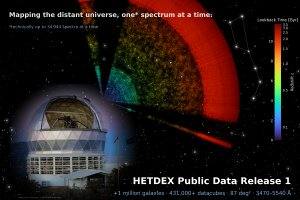
Artificial intelligence played a key role in data processing. Software provided by RAIC Labs automatically removes contamination from satellites and meteors passing in front of the telescope. HETDEX also uses automated methods to sift through observations and identify potential early galaxies. Over 24,000 citizen scientists assisted in confirming the existence of these galaxies through the "Dark Energy Explorers" project. This is the first release of the complete dataset and survey catalog. With ongoing observations and calibration improvements, additional supplementary releases are expected in the future. Data can be accessed at hetdex.org.
This article is compiled by Wedoany. All AI citations must indicate the source as "Wedoany". If there is any infringement or other issues, please notify us promptly, and we will modify or delete it accordingly. Email: news@wedoany.com