en.Wedoany.com Reported - Starlink doubled its user base and entered 35 new markets between Q1 2025 and Q1 2026, but at the cost of a 23% decline in average revenue per user (ARPU). During the same period, the company's fixed broadband revenue grew by 49.8% and operating profit by 120.4%. However, the focus of discussions on its growth strategy is shifting from "what was sacrificed" to "what else can be done."
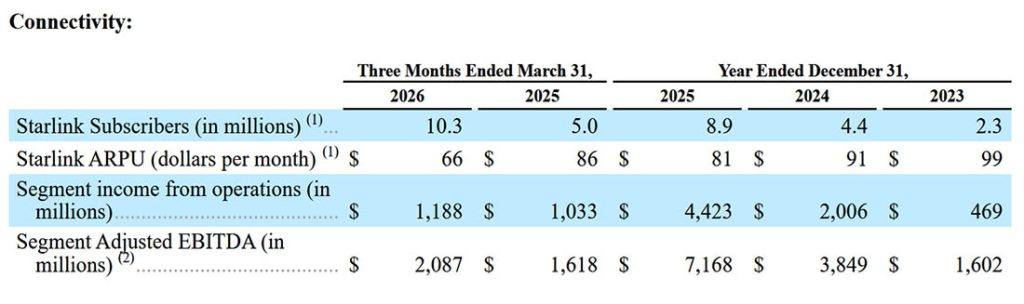
According to the latest official data, as of March 2026, Starlink had over 10.3 million users, covering 164 countries, with more than 9,600 satellites in orbit. In Q1 2026, its fixed broadband revenue reached $3.257 billion, operating profit was $1.188 billion, and adjusted EBITDA was $2.087 billion. For the full year 2025, the company's cumulative revenue was $11.387 billion, operating profit was $4.423 billion, and adjusted EBITDA was $7.168 billion. Compared to 2024, revenue in 2025 grew by 49.8%, operating profit by 120.4%, and adjusted EBITDA by 86.2%.
In terms of infrastructure investment, Starlink's total connectivity investment in Q1 2026 was $1.332 billion, a 63.6% increase from $814 million in the same period of 2025. Full-year connectivity investment in 2025 totaled $4.178 billion, indicating that even after surpassing 10 million users, the company continues to actively expand its capacity.
User growth has become increasingly rapid: 2.3 million at the end of 2023, 4.4 million in 2024, 8.9 million in 2025, and over 10.3 million in Q1 2026. From Q1 2025 to Q1 2026, the user base surged from approximately 5 million to 10.3 million, an increase of about 106%.

Changes in ARPU reveal another side of the growth story. In 2023, the average ARPU was $99; it dropped to $90 in 2024 and further declined to $81 in 2025. Quarterly data highlights the contrast even more: in Q1 2025, ARPU for approximately 5 million users was $86; one year later, ARPU for 10.3 million users fell to $66, a decline of about 23%.
The primary reason for the ARPU decline is Starlink's large-scale expansion into new markets. From Q1 2025 to Q1 2026, the company entered 35 new markets, many of which are in developing countries with economic strength and purchasing power significantly different from earlier developed markets. To adapt to the business environment in lower-income regions, Starlink adjusted its pricing strategy. Additionally, even in existing markets, the company implemented specific price reductions to accelerate user growth. For example, in Brazil, from March 2025 to March 2026, Starlink's user base nearly doubled, adding 343,500 new users, a 95.1% increase. Globally, the user base grew by 106% over the same period, close to Brazil's 95.1% growth rate.
There are signs that the aggressive expansion phase may be nearing its end. In May 2026, Starlink announced price increases in Brazil, ranging from 5% to 19%. In the United States, average increases for some plans were close to 10%. In Canada, increases ranged from 4.55% to 7.14%, while most plans in the UK rose by £5 per month. These adjustments suggest a potential shift in strategy: more mature markets may bear higher ARPU to subsidize expansion into new markets.
This expansion is linked to Starlink's assessment of market potential. In its IPO prospectus, SpaceX stated that it had identified a $1.6 trillion total addressable market (TAM), with fixed broadband accounting for $870 billion. In 2025, Starlink's 10.3 million users across 164 countries generated $11.387 billion in revenue, only 1.3% of the $870 billion TAM. After doubling its user base and entering 35 new markets within a year, the company has still captured only a tiny fraction of the market it considers addressable, making its next moves highly noteworthy.
This article is compiled by Wedoany. All AI citations must indicate the source as "Wedoany". If there is any infringement or other issues, please notify us promptly, and we will modify or delete it accordingly. Email: news@wedoany.com