en.Wedoany.com Reported - The Dutch shipbuilding industry continues to demonstrate resilience and commercial vitality in its target business areas, primarily the market for smaller tonnage vessels, applying technology in a pragmatic and efficient manner to deliver quality craftsmanship and products at acceptable price levels.
The Netherlands has a proactive and expansion-minded group of shipowners and ship managers, which significantly impacts the shipbuilding sector. Additionally, a complete supply chain, designer, and knowledge center network are key advantages.
With a distinctly Dutch style in concept and execution, "easy to build, easy to operate, easy to load" is the core design principle of the EasyMax 14,000 DWT multipurpose cargo vessel. This vessel type was jointly developed by Conoship International in Groningen, shipowner Royal Wagenborg Shipping, and shipyard Royal Niestern Sander. To date, the EasyMax platform has been used or designated for 12 newbuild vessels. Its efficient consumption per ton of payload is achieved through a 2,999 kW main engine.
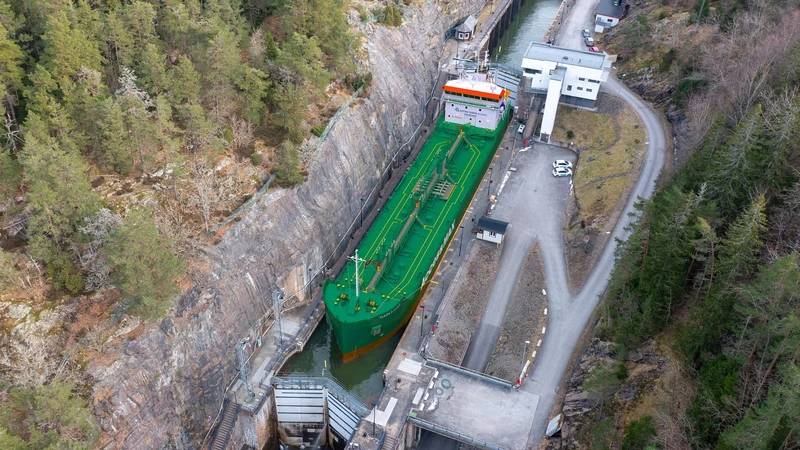
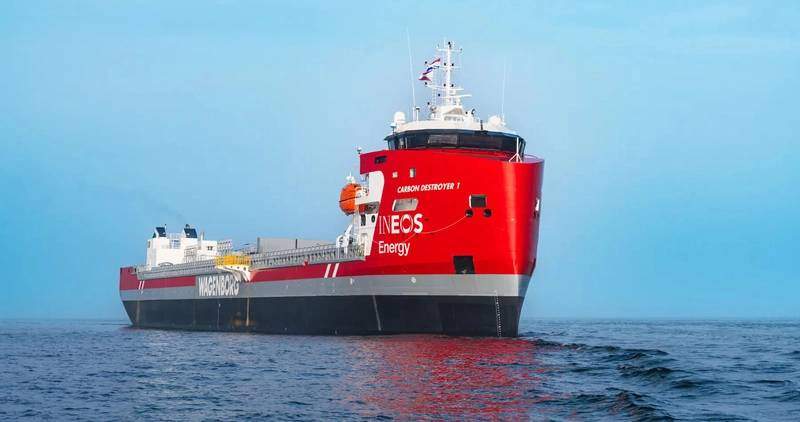
As the largest vessel type built on the landward side of the coastal dikes in the northern Netherlands, the EasyMax series now includes a variant specifically designed for transporting liquefied carbon dioxide. This newly operational vessel, named Carbon Destroyer 1, is assigned to shuttle operations, loading 5,000 tons of cargo from the port of Esbjerg on the west coast of Denmark and discharging at the Greensand offshore carbon storage site in the North Sea.
Carbon Destroyer 1 is the fifth of six Series 1 EasyMax 14,300 DWT vessels ordered within a decade. Unlike its general-purpose sister ships, this vessel is customized for the thermal behavior of liquefied carbon dioxide, requiring a specialized containment system, integrated safety zones, and a highly redundant energy and propulsion layout. Due to the stringent requirements for year-round fixed-point unloading in open seas, its dynamic positioning system meets DP2 standards. This investment by Royal Wagenborg Shipping is supported by a long-term charter agreement with the UK-based INEOS Group.
Last year, the Dutch operator approved a newbuilding project for six second-generation EasyMax cargo vessels, ensuring production continuity at Royal Niestern Sander for the next few years. Features of the six EasyMax 2 vessels include support for a range of alternative fuels, enhanced shore power connections, and improved energy management.
For decades, Conoship International has played a leading role in shaping the design and procurement of short-sea shipping and small cargo vessels, with its ongoing efforts reflected in the CIP platform covering a range up to 9,000 DWT.
At the core of the technical arrangement is a variable-frequency controlled diesel-electric power and propulsion system, which adjusts propeller speed based on variables such as engine load, water depth, and route. The design is based on small generator sets supplying power to dual electric propulsion motors, creating conditions for economically adapting generator sets powered by fuels such as methanol or hydrogen in the future, and allowing for the installation or retrofitting of Econowind Ventofoils at any time. Customization options also include battery packs and carbon capture systems.
Recent transactions include 3,600 DWT, 3,800 DWT, and 6,400 DWT versions for shipowners from the Netherlands, Germany, and Norway, bringing orders to shipyards cooperating with Conoship International in the Groningen region of the northern Netherlands, as well as builders in India and Turkey. The CIP series has recently added a 4,400 DWT variant developed from the CIP3800.
This shift from traditional single-engine, four-stroke diesel mechanical propulsion is also fully reflected in the production at Royal T Shipyards (formerly Thecla Bodewes Shipyard in Kampen on the IJssel River). This builder recently delivered the last of a series of ten 7,300 DWT diesel-electric short-sea vessels ordered by Vertom Shipping, based on the LABRAX class developed in collaboration with Groot Ship Design.
Each 119-meter cargo vessel is equipped with four main generator sets and dual asynchronous propulsion motors. The Volvo Penta generator sets integrate the Swedish company's D13 high-speed engines, each outputting 400 kW at 1,800 rpm. Another batch of LABRAX newbuildings is under construction for UK operator Carisbrooke Shipping.
Damen Shipyards Group combines the stock-building practice of standardized designs with the competitiveness derived from a globally diversified shipbuilding network. The production of its Combi Freighter (CF) series newbuildings reflects the enduring strength of the Netherlands in the short-sea cargo vessel market. In particular, the latest version of the 90-meter CF3850, a 3,850 DWT single-hold cargo vessel suitable for a variety of bulk commodities and industrial products, has attracted significant interest.
After Damen Shipyards Group delivered multiple vessels of the original form of this class over more than 20 years, the CF3850 was redesigned, updated, and released in the early 2020s. Market acceptance has been extremely high; as of the end of March 2026, the modified design has attracted a total of 50 sales in just over five years, with 38 units delivered.
For this latest iteration, construction is concentrated at the Yangtze River facility of the affiliated company Damen Yichang in China, and more recently at the Ba Son Shipyard, a partner of the Dutch group in Vietnam. The redesigned CF3850 uses a six-cylinder DZC medium-speed main engine from Anglo Belgian Corporation (ABC). The modest 1,104 kW output—approximately 50% lower than the MaK power unit fitted on earlier CF3850s—has a positive impact on the EEDI rating and CO2 emissions.
One of Damen Shipyards Group's strongest advantages is its ability to ensure early or rapid delivery through its stock-building strategy. From the buyer's perspective, the short cycle from contract to completion reduces overall project costs and risks and helps quickly respond to market opportunities. The continuous evolution of the CF3850 is guided by operator feedback.
The value of long-term cooperation is once again highlighted by new business obtained by Ferus Smit from Sweden's Erik Thun Group. In this relationship, the contractor consistently remains fully adaptable to market conditions and the specific requirements of the client. Two newbuild 4,500 DWT tankers will feature a design allowing navigation in ports and terminals of Sweden's inland lake system while ensuring flexibility for operations in the wider North Sea and Northwest Europe. The shallow-draft AccessMAX class offers a 10% increase in cargo capacity compared to previous generations, improving cost efficiency per ton. To date, Thun has received over 50 cargo vessels and tankers built by Ferus Smit, primarily from the main yard in Westerbroek near Groningen, but also from the Dutch builder's Leer yard across the German border.
This article is compiled by Wedoany. All AI citations must indicate the source as "Wedoany". If there is any infringement or other issues, please notify us promptly, and we will modify or delete it accordingly. Email: news@wedoany.com