en.Wedoany.com Reported - Silicon Labs emphasizes that integrating security, trust, and resilience into every IoT solution from the outset is crucial.

The world is rapidly becoming a network of interconnected ecosystems. From industrial robots precisely assembling vehicles to smart meters balancing supply and demand, from wearable devices monitoring patient health to connected logistics systems tracking cross-border goods, the Internet of Things (IoT) has deeply integrated into real life. These innovations are reshaping industries and redefining how society operates. Trust lies at the heart of this transformation. The IoT acts as the nervous system of the modern economy: every sensor, gateway, and connected device collects and transmits critical data, informing decisions, enhancing efficiency, and driving innovation. However, this also means that every connection can be a potential vulnerability. Cyberattacks against manufacturers are rising sharply worldwide, and fewer than half of companies consider themselves prepared, placing the global IoT ecosystem at a critical crossroads.
Risks are escalating. The IBM 2025 Cost of a Data Breach Report shows that the average cost of a data breach globally has climbed to $4.82 million, with critical sectors like healthcare, finance, and energy hit hardest. Meanwhile, studies predict that over 125 billion IoT devices will be in operation globally by 2030. Whether targeting a factory, hospital, or energy grid, attackers exploit the weakest link, and in a highly interconnected world, such a weak link can trigger global disruption.
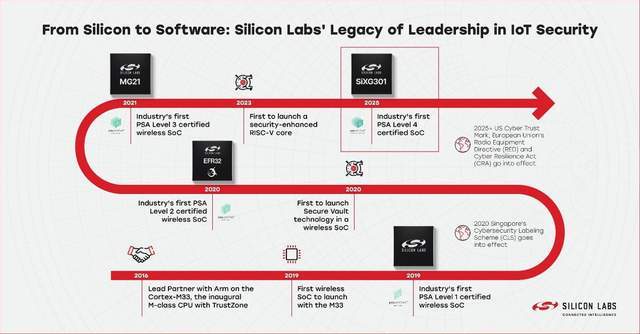
Governments and regulators worldwide are demanding stricter security measures from connected device manufacturers to enhance information security. Regulations such as the European Radio Equipment Directive (RED) and the Cyber Resilience Act (CRA) have made security and privacy top priorities for regulatory scrutiny. The RED Delegated Act, effective in 2025, imposes a series of basic cybersecurity requirements for wireless devices, including protection against cyberattacks, safeguarding personal data, and preventing misuse.
For this reason, security can no longer be treated as an afterthought. It must be integrated into the architecture of every IoT solution, covering design, manufacturing, deployment, and lifecycle management. Devices must establish a root of trust at the chip level, employ secure boot processes, and support authenticated encrypted communications. Equally important, they must be able to adapt to evolving threat landscapes through remote over-the-air updates and robust lifecycle protection mechanisms.
Progress is being made. As companies like Silicon Labs continue to drive innovation in information security technology, clear, actionable paths for verification and implementation are emerging. For example, certification standards like PSA provide a trusted benchmark, demonstrating that IoT solutions can offer independently verified resilience against software and hardware attacks. This assurance is critical for industries where security and trust are non-negotiable.
These standards highlight the value of security technology innovations from leading vendors. For instance, Silicon Labs' Secure Vault in its third-generation wireless SoCs has achieved PSA Level 4 certification, the highest level of PSA Certified, providing protection against advanced physical attacks. Secure Vault and the PSA certification framework enable secure boot and key storage while protecting sensitive data from extraction, tampering, or leakage. Achieving PSA Level 4 certification further enhances protection, equipping devices with extremely high physical security to ensure data privacy even in extreme threat environments.
The global IoT market continues to expand rapidly. According to GlobalData, IoT adoption in manufacturing, energy, healthcare, and consumer technology is accelerating, with billions of devices expected to connect over the next decade. However, this growth heightens the urgency to address security at scale. A single compromised sensor in a factory could halt production lines; an insecure medical device could endanger lives; a vulnerable smart meter network could destabilize the power grid.
Security should not be merely a feature but must become the foundation of an intelligent, connected world. Businesses and governments must look beyond cost and speed, prioritizing solutions that offer verifiable security. Certification frameworks, compliance with international standards, and continuous threat monitoring should be prerequisites, not options. As markets like the EU and the US introduce increasingly stringent regulations, information security is becoming a barrier to market entry.
The future holds immense opportunities. The IoT can enhance efficiency, enable smarter healthcare, reduce environmental impact, and build more resilient supply chains. But these benefits can only be realized when trust is embedded in every connection. The winners in the IoT era will not be the companies with the broadest connectivity, but those that are most trusted. The industry should not just build innovative IoT systems; it must build systems that are resilient, secure, and trustworthy from the ground up.
This article is compiled by Wedoany. All AI citations must indicate the source as "Wedoany". If there is any infringement or other issues, please notify us promptly, and we will modify or delete it accordingly. Email: news@wedoany.com